Isoplanchol A, a New Phenolic Stereoisomer from Uncaria Gambir Sap with Antioxidant and Predicted Cyclin-Dependent Kinase 1 Binding Potential
Abstract
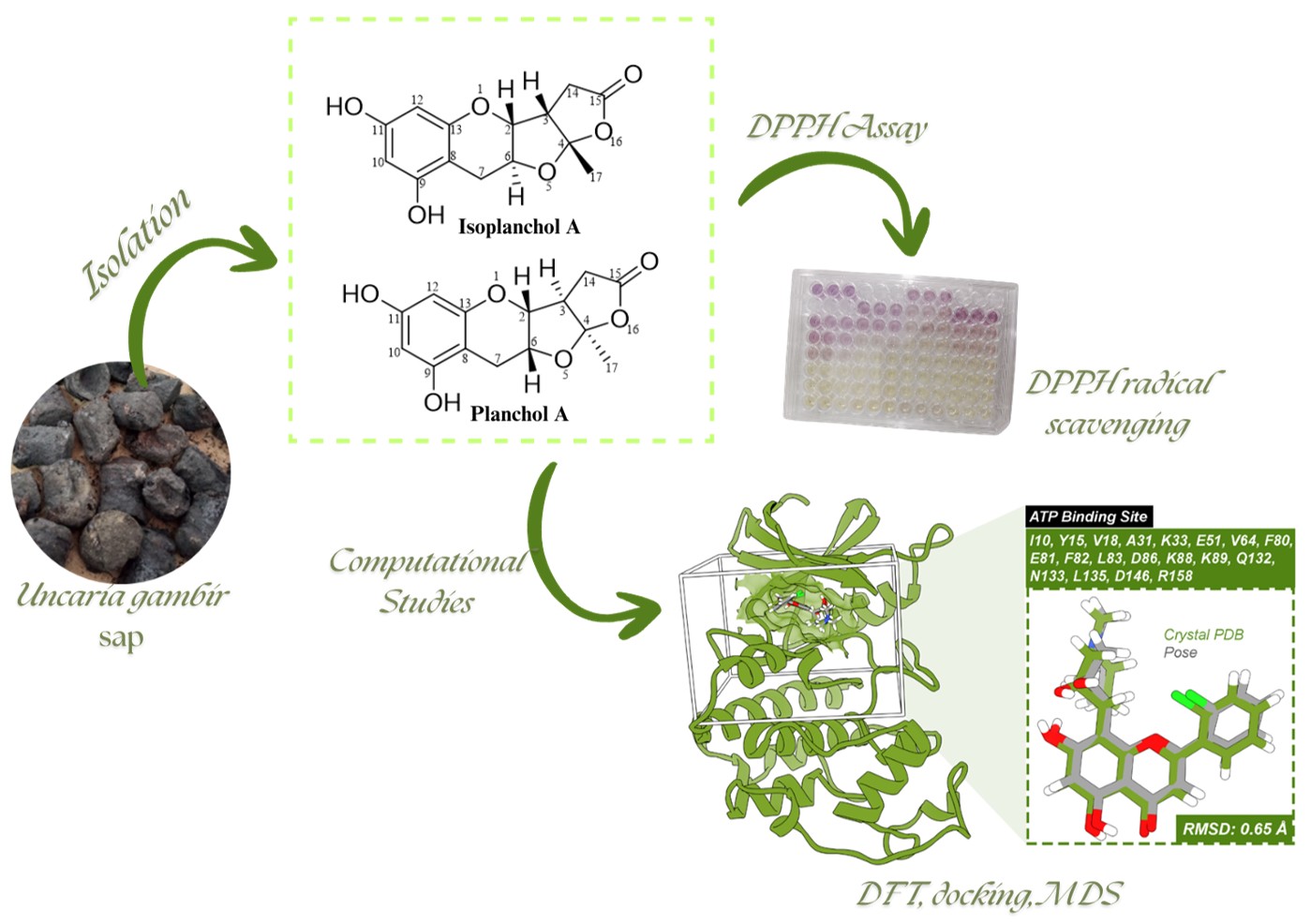
Phenolic compounds of Uncaria gambir Roxb. are known for their antioxidant properties. The methanolic extract of gambir sap yielded the known planchol A (1) and a new stereoisomer, isoplanchol A (2), whose structures were elucidated by Ultraviolet–visible spectroscopy (UV-Vis), Fourier-transform infrared spectroscopy (FT-IR), One-dimensional nuclear magnetic resonance/ Two-dimensional nuclear magnetic resonance (1D/2D NMR), and Direct analysis in real time–high-resolution mass spectrometry (DART-HRMS). In the 2,2-Diphenyl-1-picrylhydrazyl (DPPH) assay, Half-maximal inhibitory concentration (IC50) values were 91.86 ± 0.50 µg/mL for the extract, 162.11 ± 1.65 µg/mL for 1, and 89.67 ± 0.74 µg/mL for 2. In the 2,2′-Azino-bis(3-ethylbenzothiazoline-6-sulfonic acid) (ABTS) assay, IC50 values were 79.76 ± 0.36 µg/mL for the extract, 14.53 ± 0.21 µg/mL for 1, and 20.22 ± 0.50 µg/mL for 2, comparable to catechin (17.02 ± 0.08 µg/mL); the isomers’ order was reversed relative to DPPH, indicating assay-dependent activity. Density functional theory calculations gave similar Highest occupied molecular orbital-Lowest unoccupied molecular orbital (HOMO-LUMO) gaps (5.73–5.85 eV) for both. Molecular docking and 300 ns molecular dynamics simulations predicted stable binding of both compounds in the Adenosine triphosphate (ATP)-binding pocket of cyclin-dependent kinase 1 (CDK1), with a more favorable Molecular mechanics-Generalized born surface area (MM-GBSA) binding free energy for 2 (ΔGbind = –29.95 kcal/mol) than for 1 (–26.44 kcal/mol). These in silico results are hypothesis-generating and require experimental validation. Gambir sap is a source of antioxidant phenolics, and isoplanchol A (2) is a candidate for further biological investigation.