Integrating System Dynamics and Circular Economy for Resilient Soybean Supply Chains in a Renewable Energy Transition
Abstract
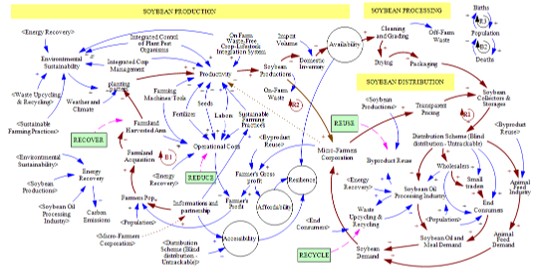
Indonesia’s soybean supply chain depends heavily on imports, while tofu and tempeh processing generates substantial quantities of underutilized organic waste. Although previous studies have examined soybean production, waste treatment, and bioenergy separately, their combined long-term dynamics within Indonesia’s soybean system remain insufficiently understood. This study addresses that gap by developing a system dynamics (SD) framework that represents agricultural production, soybean demand, processing waste, biogas recovery, energy costs, and supply-chain resilience. The intervention combines dolomite application, Rhizobium inoculation and saturated soil culture. Recovered liquid waste is converted into biogas to reduce liquefied petroleum gas (LPG) purchases, while solid waste is treated separately. Over 2026–2040, the mean modeled composite resilience index was approximately 65.1 points under the intervention and 46.0 points under the existing practices. The difference was approximately 19.1 index points across the specified economic and soybean-supply indicators. The economic simulation also showed net profit approaching IDR 6,000 per modeled hectare by 2040. Sensitivity testing indicated that profitability depends strongly on operating costs, with simulated profit approaching zero when annual operating expenses reach approximately 15.6% of digester investment. These findings demonstrate how integrated agricultural management and waste-to-energy interventions can support soybean supply-chain planning in Indonesia.