Molecular Insights into the Antidiabetic Potential of Excavatin-A as an α-Glucosidase Inhibitor: An Integrated Molecular Docking and Molecular Dynamics Study

Muhammad Ikhlas Abdjan1,2

Nanik Siti Aminah3,4, Email

Alfinda Novi Kristanti3,4

Abdullahi Musa5

Imam Siswanto3

Axl Laurens Lukas Windah3,6

Tin Myo Thant7,8

Yoshiaki Takaya9

Salar Hafez-Ghoran10

Yan Wang7

1Departement of Chemistry, Faculty of Science and Technology, Airlangga University, Surabaya, East Java, 60115, Indonesia
2Department of Chemistry, Faculty of Mathematics and Natural Science, State University of Surabaya, Surabaya, East Java, 60231, Indonesia
3Department of Chemistry, Faculty of Science and Technology, Airlangga University, Surabaya, East Java, 60115, Indonesia
4Biotechnology of Tropical Medicinal Plants Research Group, Airlangga University, Surabaya, East Java, 60115 Indonesia
5Floret Center for Advanced Genomics and Bioinformatics Research, Chemistry, Ikeja, Lagos, 100271, Nigeria
6Faculty of Science and Technology, Airlangga University, Surabaya, East Java, 60115, Indonesia
7Key Laboratory for Chemistry and Molecular Engineering of Medicinal Resources (Ministry of Education of China), Guangxi Key Laboratory of Chemistry and Molecular Engineering of Medicinal Resources, University Engineering Research Center for Chemistry of Characteristic Medicinal Resources (Guangxi), School of Chemistry and Pharmaceutical Sciences, Guangxi Normal University, Guilin, Guangxi, 541004, China
8Department of Chemistry, Panglong University Ministry of Education, Shan, Panglong, 06114, Myanmar
9Faculty of Pharmacy, Meijo University, 150 Yagotoyama, Tempaku, Nagoya, 468-8503, Japan
10Laboratory for Functional Foods and Human Health, Center for Excellence in Post-Harvest Technologies, North Carolina Agricultural and Technical State University, North Carolina Research Campus, 500 Laureate Way, Kannapolis, North Carolina, 28081, United States


Abstract

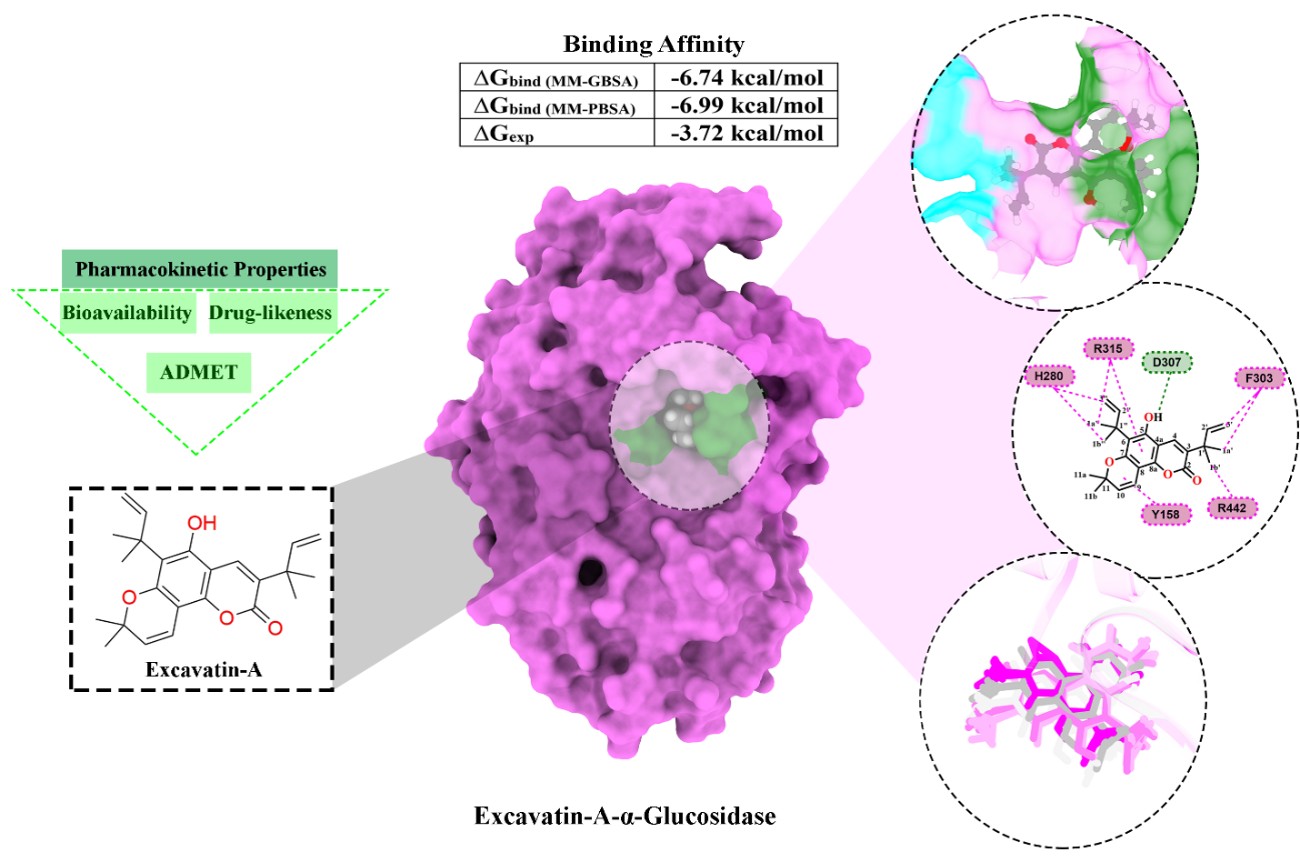
α-Glucosidase enzymes were targeted to hydrolyse oligosaccharides into monomers, thereby increasing blood glucose levels in people with type 2 diabetes mellitus (DM). Natural products offer diverse, accessible compounds for drug discovery. Excavatin-A (ExA) is a new compound of coumarin derivatives that has quite a structural similarity to nordentatin (Nor) and has been known as a promising α-Glucosidase inhibitor. Through a structure-based approach, the interaction of these compounds with α-Glucosidase at the molecular level was studied. For evaluation purposes, the compounds Nordentatin and acarbose (Aca) were used as controls. The results showed that the dynamic behaviour of each system reached equilibrium over the simulation time, as indicated by stability and rigidity analyses. Meanwhile, the theoretical (∆Gbind) and experimental (∆Gexp) binding affinities show a good correlation, with Aca-α-Glu > ExA-α-Glu > Nor-α-Glu. Moreover, the residue on the gate pocket (especially Y158) leads to stabilising ExA binding with a decomposition energy (〖"∆G"〗_"bind" ^"residue" ): -3.28 kcal/mol. ExA shows its potential as a promising drug candidate by meeting the Lipinski rules (only one violation), good bioavailability (0.55), good oral absorption (+Human Intestinal Absorption(HIA)), and non-toxicity (non-AMES and non-hepatotoxicity). This work provided useful molecular insights into Excavatin-A as a potential α-glucosidase inhibitor.
Molecular Insights into the Antidiabetic Potential of Excavatin-A as an α-Glucosidase Inhibitor: An Integrated Molecular Docking and Molecular Dynamics Study