Non-Polar Compounds from the Fresh Stem of Aquilaria malaccensis: An Integrative In-Vitro and In-Silico Investigation
Abstract
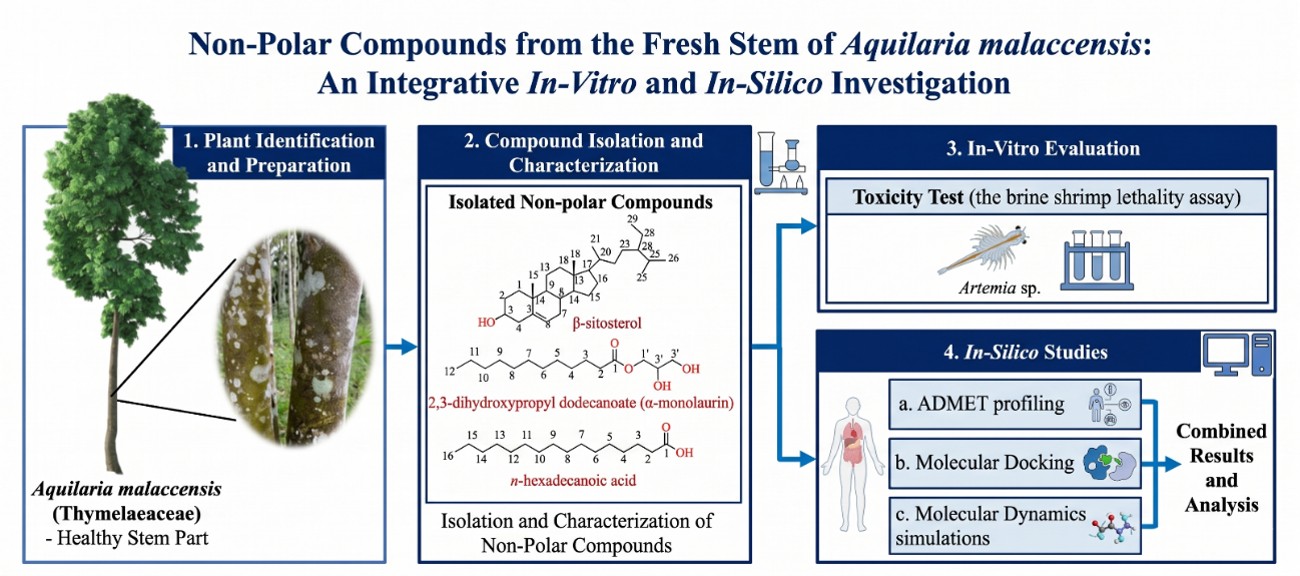
Aquilaria malaccensis (Thymelaeaceae), a key agarwood-producing species widely distributed across Southeast Asia, is known for its rich phytochemical diversity and associated bioactivities. This study aimed to isolate non-polar secondary metabolites from the fresh stem of A. malaccensis and evaluate their biological and in silico potential. Extraction was performed via methanol maceration, followed by solvent partitioning with n-hexane and ethyl acetate. Purification using thin-layer chromatography (TLC), vacuum liquid chromatography (VLC), and gravity column chromatography (GCC) yielded three compounds: β-sitosterol, 2,3-dihydroxypropyl dodecanoate, and n-hexadecanoic acid. Structural elucidation was achieved using fourier transform infrared spectroscopy (FTIR), ultraviolet–visible spectroscopy (UV–Vis), and nuclear magnetic resonance (NMR) spectroscopy, and confirmed by comparison with reference data. Preliminary toxicity screening against Artemia salina L. larvae using the Brine Shrimp Lethality Method indicated LC50 values of 41.35 ppm for the methanol extract, 45.25 ppm for the n-hexane extract, 51.65 ppm for β-sitosterol, and 98.99 ppm for 2,3-dihydroxypropyl dodecanoate (α-monolaurin). Further in silico evaluation, including absorption, distribution, metabolism, excretion, and toxicity (ADMET) profiling, molecular docking, and 100 ns molecular dynamics simulations, was conducted against the Sirtuin 1 (SIRT1) target. While n-hexadecanoic acid showed unfavorable pharmacokinetic properties, β-sitosterol and 2,3-dihydroxypropyl dodecanoate demonstrated promising binding interactions within the active site. In particular, β-sitosterol exhibited the most favorable binding affinity (ΔGbind = −36.47 kcal/mol) and stable complex formation compared to the native ligand and doxorubicin as a reference drug. This study provides additional phytochemical information on the non-resinous fresh stem of A. malaccensis. Overall, this study highlights A. malaccensis as a valuable source of bioactive compounds and identifies β-sitosterol as a potential scaffold for the development of SIRT1-targeted therapeutics.