Climate-Resilient Agriculture: Machine Learning Models for Predicting Crop Stress and Adaptive Farming Strategies
Abstract
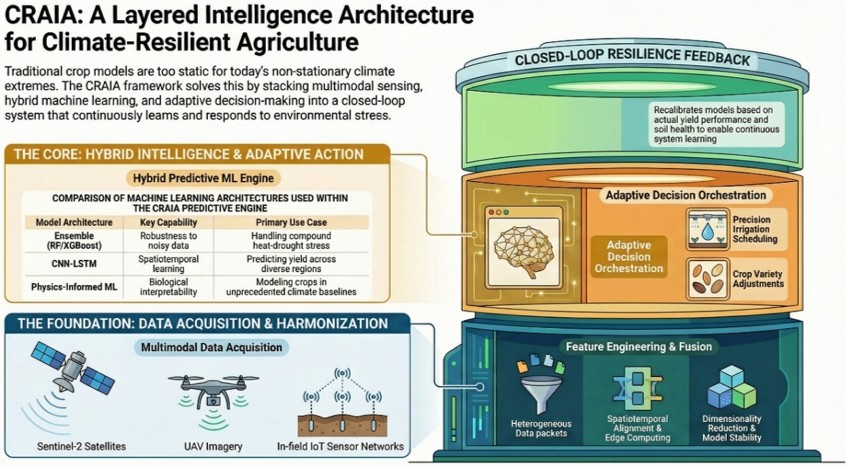
Climate change is exacerbating thermal extremes, hydrological variability, and compound climatic events, posing systemic threats to global agricultural productivity and food security. Although machine learning (ML), remote sensing, and Internet of Things (IoT) technologies have contributed to the growth of crop stress detection and yield prediction, the current body of work remains scattered across sensing infrastructures, predictive modelling, and adaptive decision-support systems. The paper is a systematic integrative review of interdisciplinary literature (2010-2024) on climate science, crop modelling, digital agriculture, and artificial intelligence to synthesise the research and highlight structural constraints. The discussion shows that although ensemble learning, deep neural networks, and multimodal data fusion have enhanced predictive accuracy, deterrent gaps remain in cross-climatic transferability, uncertainty quantification, interpretability, governance integration, and closed-loop feedback architecture. The paper offers a solution to these shortcomings in the form of a layered feedback-driven system known as the Climate-resilient Agricultural Intelligence Architecture (CRAIA), which combines an environmental data acquisition system, harmonising features, hybrid predictive intelligence, an adaptive decision coordination system, and resilience recalibration into a governance-conscious scalability framework. The results show that climate resilience is not achieved with predictive accuracy alone, but rather requires integrating predictive accuracy with intelligent systems that can continuously learn and respond to climatic uncertainty. This research provides a conceptual basis for next-generation climate-resilient agro-ecosystems aligned with global sustainability and adaptation goals by developing a systems-level architectural paradigm.