Effects of Plant Growth-Promoting Rhizobacteria on Ginseng Physiology, Ginsenoside Accumulation and Rhizospheric Soil Properties
Abstract
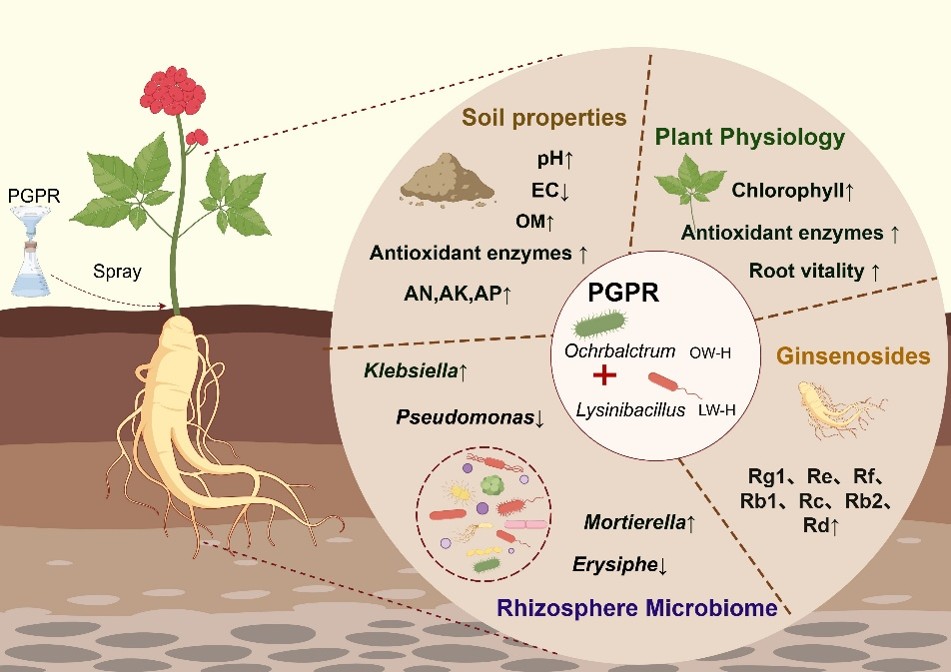
The ginseng industry's heavy reliance on chemical fertilizers and pesticides has negatively impacted the environment and reduced ginseng quality. In this study, we examined the effects of two plant growth-promoting rhizobacteria (PGPR), Ochrobactrum sp. O-WH and Lysinibacillus L-WH, on soil properties and ginseng growth. Pot experiments revealed that co-inoculation with PGPR significantly increased the activities of key enzymes, including urease (URE), acid phosphatase (ACP) and sucrase (SC) activity. In addition, the end of life (EOL) significantly enhanced the accumulation of monomeric ginsenosides, with the contents of Rg1 + Re, Rb1, Rc, and Rd reaching 1.69, 1.48, 1.46, and 0.46 mg·g-1, respectively, which were 30.0%, 24.4%, 14.1% and 31.4% higher than those of the CK group. High-throughput sequencing was employed to assess rhizosphere microbial community composition and abundance. Notably, combined inoculation markedly elevated the levels of available phosphorus (AP, up to 51.62 mg·kg-1), available potassium (AK, up to 215.92 mg·kg-1), and available nitrogen (AN, up to 195.34 mg·kg-1) compared with single-strain treatments. Relative to the control (CK), PGPR treatment reduced the bacterial diversity of rhizosphere microorganisms and increased the fungal diversity, with the relative abundance of Klebsiella, Pseudomonas and Mortierella showing an increasing trend, while the relative abundance of Erysiphe decreased. Redundancy analysis further indicated a positive correlation between Klebsiella distribution and AK as well as most soil enzyme activities except ACP and between Mortierella abundance and AN, soil electrical conductivity (EC), organic matter (OM) and ACP activity. Collectively, these findings highlight the combined effects of PGPR at the rhizosphere-plant interface, enhancing soil fertility, microbial diversity, and ultimately ginseng quality.