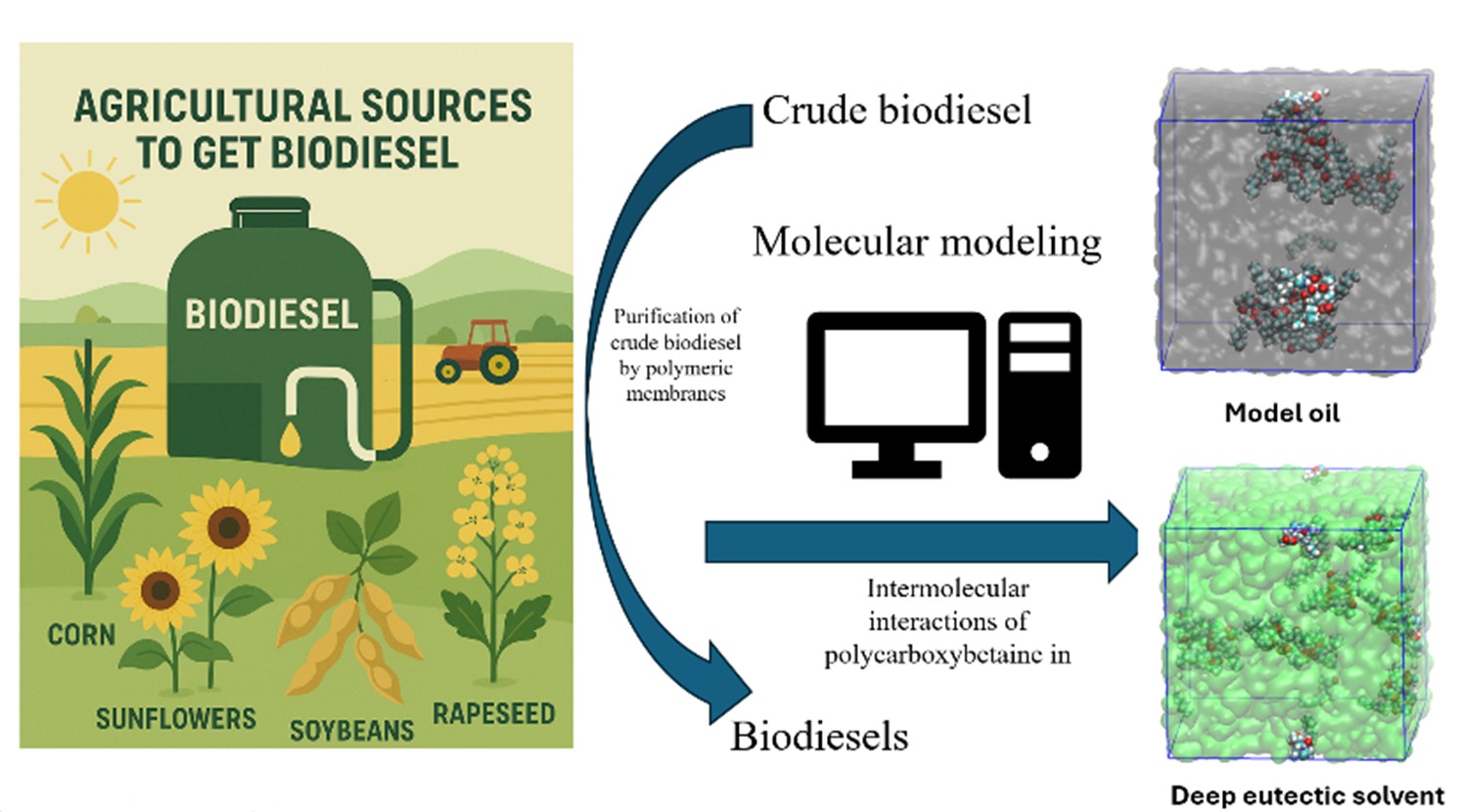
Multiscale Molecular Modeling of Amphiphilic Polycarboxybetaine Interactions in Hydrocarbon and Deep Eutectic Solvent Environments for Sustainable Agricultural Biodiesel Purification
Abstract
Amphiphilic polycarboxybetaines are zwitterionic polymers containing both hydrophilic and hydrophobic regions, with quaternary ammonium and carboxylate groups that enable aggregation and dissolution in diverse solvent environments. In this work, a multiscale molecular modeling approach was employed to investigate amphiphilic polycarboxybetaine interactions in deep eutectic solvent and hydrocarbon environments, providing insights relevant to sustainable agricultural biodiesel purification. Density Functional Theory calculations and classical all-atom Molecular Dynamics simulations were applied to study the solubility and intermolecular interactions of poly (octyl-, tetradecyl-, and octadecyl-grafted aminocrotonate-methacrylic acid) oligomers in octane and tetraethylammonium hydroxide/urea-based deep eutectic solvent. DFT analyses, including optimized geometries, molecular electrostatic potential maps, and non-covalent interaction surfaces, revealed distinct solvent–polymer affinities. MD simulations demonstrated that longer alkyl chains enhance aggregation in octane, while strong interactions between hydroxide ions and carboxylate groups in deep eutectic solvent promote polymer dissolution and stabilization. These multiscale insights highlight the superior solvation ability of deep eutectic solvents compared to hydrocarbons and underscore their potential as green, tunable media for polymer solvation processes associated with biodiesel purification. This study advances molecular-level understanding of how solvent environments modulate amphiphilic polycarboxybetaine behavior, supporting the design of environmentally friendly solvents for energy and materials applications.