Heterogeneity of Ethanolic Extract of Lycium Chinense Miller and its Multi-target Anti-Lung Cancer Mechanism in Calu-1 Cells
Abstract
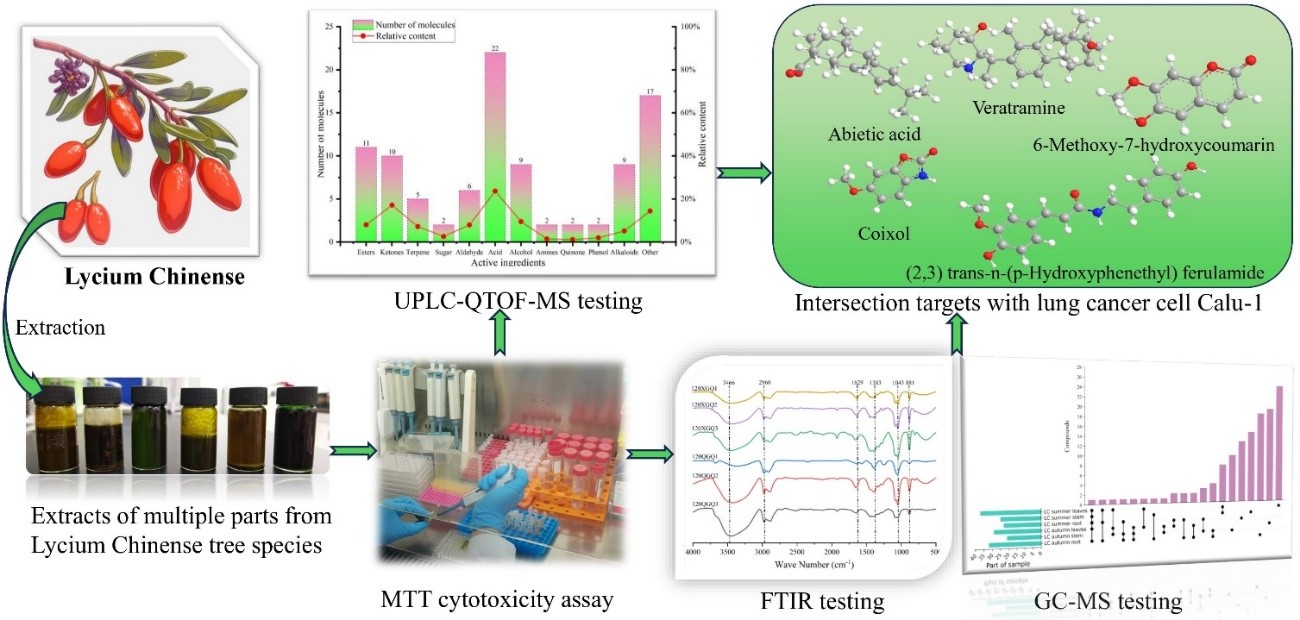
In this study, the inhibitory effect of ethanol extract of Lycium chinense on human lung cancer cell line Calu-1 and its molecular mechanism were investigated. The chemical composition dynamics of Lycium chinense extracts in different seasons and organs and their inhibitory effects on lung cancer Calu-1 cells were revealed by multi-dimensional analysis. Methylthiazolyldiphenyl-tetrazolium bromide assay showed that the cytotoxicity (%) of summer stem extract was the strongest (57.51%, p<0.0001), followed by autumn leaves (54.43%). Fourier Transform infrared spectroscopy and Gaschromatography-mass spectrometry analysis showed that the summer and autumn leaves, stems and roots contained Phytol, Ethyl linoleate, Falcarinol, Gamolinic acid and other anticancer, anti-tumor and anti-inflammatory active components. Ultra Performance Liquid Chromatography-Time of Flight Mass Spectrometry identified that acids (23.62%) and ketones (17.12%) were the core of non-volatile components in summer stems, and found that abietic acid, resveratrol and other anticancer active components. Five active ingredients (Abietic acid, Veratramine, Coixol, 6-Methoxy-7-hydroxycoumarin, and (2,3) trans-n- (p-Hydroxyphenethyl) ferulamide) were revealed from network pharmacological analysis predictions to target 29 lung cancer-related genes, indicating a multi-target therapeutic mechanism. The results show that the spatial and temporal heterogeneity of secondary metabolites of Lycium chinense is closely related to its antitumor activity, which provides a scientific basis for optimizing harvesting strategies and developing multi-target drugs.