1. Introduction
Calligonum L., a shrub of the family Polygonaceae, is
well adapted to arid and semi-desert environments. Although it is not endemic,
its distribution is confined to specific dry regions.[1] Characterized by whitish or gray branches, small
scaly leaves, and pinkish-white flowers, it is widespread throughout Central
Asia, including Kazakhstan, Uzbekistan, Turkmenistan, Iran, Afghanistan, and
Pakistan. This genus plays a crucial role in preventing erosion through dune
stabilization and is highly effective in combating desertification. In arid
regions, Calligonum species provide important forage for camels and
goats, and their wood is traditionally used as firewood.[2] In
traditional medicine, they are valued for their diuretic, anti-inflammatory,
and antidiabetic properties, although scientific studies on these effects
remain limited.[3] Due to their richness in flavonoids and
phenolic compounds, these plants are also believed to possess strong
antioxidant activity. However, overgrazing, habitat degradation, and climate
change pose serious threats to natural populations, emphasizing the ecological
significance of Calligonum in the conservation and sustainable
management of arid ecosystems.
In Kazakhstan, C. leucocladum (Schrenk) Bunge
is one of the dominant shrub species inhabiting the sandy deserts of the
Balkhash, Saryesik-Atyrau, and Taukum regions Fig. S1.
These areas are characterized by extreme temperature fluctuations, low
precipitation, and intense wind erosion. This species plays a key role in
stabilizing mobile and semi-fixed sands and contributes to the restoration of
vegetation cover in degraded dune systems. Its extensive root system and
pronounced xerophytic morphology enable it to withstand prolonged drought and
salinity stress, making it an excellent model for studying plant adaptation to
arid environments.[4]
Furthermore, its role in maintaining soil structure, enhancing microhabitat
diversity, and providing food and shelter for desert fauna highlights its
importance in sustaining the fragile desert ecosystems of Central Asia.[5]
The chloroplast genome of Calligonum represents
a specialized genetic entity responsible for regulating the photosynthetic and
metabolic processes of this plant. Consistent with typical plant chloroplast
genomes, it is circular, approximately 150–160 kilobases in length, and
contains genes related to photosynthesis (e.g., psa, psb, rbcL),
ribosomal RNAs, and transfer RNAs.[6] Although its overall gene arrangement is similar to
other members of the Polygonaceae family, Calligonum exhibits
species-specific variations in intergenic regions. Chloroplast DNA serves as an
effective tool for taxonomic classification and for elucidating evolutionary
relationships, particularly through marker genes such as rbcL and matK.[7] Furthermore, cpDNA provides insights into the genetic
mechanisms underlying plant adaptation to arid conditions. Although complete
plastome sequences of Calligonum species have only recently begun to
emerge, data from related taxa offer valuable information about plastome
evolution and structural diversity. Such genomic resources are essential for
biodiversity conservation and the sustainable utilization of desert plants.
Understanding the genetic architecture of C. leucocladum
has important implications for ecological restoration and agroforestry
development in arid regions. As a native, drought-tolerant shrub, it can be
effectively utilized in afforestation and sand dune stabilization programs
aimed at combating desertification.[8] Integrating genomic data with ecological information
will help identify resilient genotypes suitable for re-vegetation, soil
protection, and agroforestry applications.[9] Moreover, genomic insights into stress tolerance and adaptation can
support sustainable land management strategies and contribute to biodiversity
conservation under changing climatic conditions. This study therefore bridges
molecular biology and applied ecology, aligning with the broader goals of
promoting sustainable bioresource utilization and enhancing environmental
resilience in dryland ecosystems.
Recent advances in next-generation sequencing (NGS)
technologies have provided unprecedented opportunities to investigate plant
chloroplast (cp) genomes in detail. Currently, the cp genome database comprises
more than 3,800 species.[10]
However, most of these belong to economically or medicinally important taxa,
while genomic information on desert-adapted species such as Calligonum
remains scarce. In this study, we sequenced and analyzed the complete
chloroplast genome (cpDNA) of C. leucocladum collected from different
regions of Kazakhstan using the Illumina HiSeq2500 platform. The main
objectives were to (i) elucidate the structural characteristics of the
chloroplast genome of this ecologically significant species and (ii) clarify
its phylogenetic position within the Polygonaceae family. The findings of this
study enhance our understanding of the evolutionary relationships among
arid-zone plants and provide a genomic foundation for the conservation and
sustainable use of Calligonum species. Furthermore, these plastome data
will serve as a valuable reference for future comparative genomic and
phylogenetic studies of the Polygonaceae family.
2. Materials and methods
2.1 Study species
C. leucocladum (Schrenk) Bunge belongs to the family Polygonaceae,
subfamily Polygonoideae, tribe Calligoneae. The genus Calligonum
comprises shrubs well adapted to desert and semi-desert environments,
displaying a pronounced xeromorphic habit. The species has been recorded under
several synonyms, including C. anfractuosum Bunge and C. elegans,
although the accepted name in modern taxonomy remains C. leucocladum.[11-13] Global databases such as POWO and WFO
confirm its taxonomic status and list infraspecific taxa.[14]
Morphologically, C. leucocladum is a shrub
ranging from 0.5 to 1.5 m in height. Older branches are grayish-yellow and
tortuous, while the younger green shoots are articulated and photosynthetic.
Leaves are reduced to minute scales, with photosynthesis occurring primarily in
the green branchlets. Flowers are small, solitary or in groups of two to three,
with a five-lobed perianth. The fruit is a nutlet bearing three large, rounded
membranous wings with distinctly serrate-ciliate margins, often pinkish at early
stages and turning brown upon maturity.[15,16]
The species flowers in April–May and fruits in
May–June. Ecologically, it is a typical xerophyte and psammophyte, inhabiting
mobile and semi-fixed sands, barchans, sandy river terraces, and open saxaul (Haloxylon)
woodlands. Its physiological adaptations include drought resistance, which is
supported by enhanced antioxidant activity and soluble sugar accumulation under
prolonged water deficit.[17]
The geographic range of C. leucocladum extends
across Central Asia, occurring in Kazakhstan, Turkmenistan, Uzbekistan,
Kyrgyzstan, Tajikistan, eastern Iran, and Xinjiang (China). In Kazakhstan, it
is particularly abundant in the Balkhash sands (Saryesik-Atyrau, Taukum), the
Ili River valley, the Syr Darya basin, and the Kyzylkum Desert.[18-20] In Uzbekistan, it is recorded from the Kyzylkum and
the Sokh River basin.[21] These
distribution patterns confirm the species as a characteristic shrub element of
the Turanian desert flora.
Ecologically, C. leucocladum plays an important
role in sand dune stabilization, providing microhabitats for associated desert
flora and fauna. By reducing aeolian erosion, it contributes to the structural
integrity of desert ecosystems.[22]
Its economic significance is indirect, being primarily linked to pasture
protection and biodiversity conservation. Nevertheless, localized populations
are vulnerable to anthropogenic pressure, particularly overgrazing and wood
harvesting.[23]
C. leucocladum is a characteristic desert shrub of Central Asia,
exhibiting morphological and physiological adaptations to arid conditions and
performing a crucial ecological role in stabilizing sandy ecosystems. Its study
is of both taxonomic and applied importance, with direct relevance to
biodiversity conservation and the sustainable management of arid landscapes.
2.2 Plant materials and genomic DNA isolation
C. leucocladum was collected from 3 populations in Kazakhstan. The
studied materials were coded as P1, P2, and P3 according to population
nomenclature. The materials were deposited at the Institute of Botany and
Phytointroduction, KLKHZhM MENR RK, and the collected data are available in Table 1. A population location map is shown in (Fig. 1.)
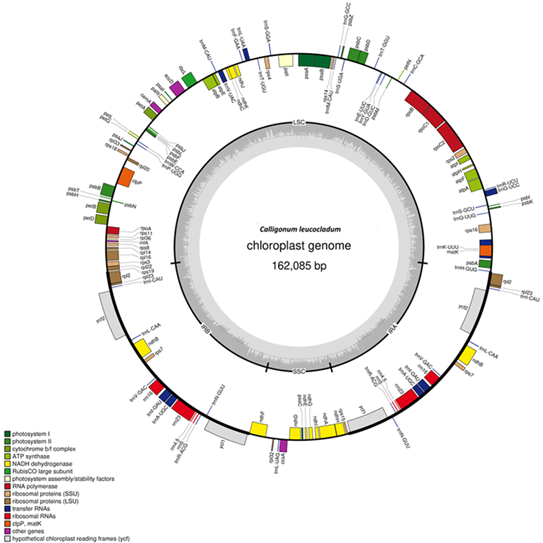
Fig. 1: Circular gene map of the C.
leucocladum chloroplast
genome. Genes located inside and outside of the circle are transcribed in the
clockwise and counterclockwise directions, respectively. LSC large single-copy
region; SSC – small single-copy region; IR – inverted repeat region.
Table 1: Population location
information used in the study.
|
Specimen
|
Herbarium code
|
Altitude
|
Location
|
|
P1
|
0003453
|
369 m
|
Balkhash-Alakul fl.r., Almaty region. Balkhash district, sands Taukum.
|
|
P2
|
0003452
|
403 m
|
Balkhash-Alakul fl.r., Almaty region.
Balkhash district, Saryesik-Atyrau sands, Near the village. Bacanas
|
|
P3
|
0003451
|
482 m
|
Balkhash-Alakul fl.r., Almaty region.
Balkhash district, sands Saryesik-Atyrau, Malaysary
|
Total gDNA was isolated from a 50 mg fresh leaf
sample, with some modifications to the method described by Li et al.[24] This NaCl precipitation step was repeated twice. The
quality and quantity of the isolated total DNAs were checked using Nanodrop
(Thermo Scientific, USA) and Qubit (Invitrogen, USA). For library construction,
≥5–10 µg of DNA at concentrations ≥50 ng/µL and OD260/280 between
1.8 and 2.0 were used.
2.3 Genome sequencing, de novo assembly, annotation,
and visualization
The Illumina TruSeq Nano DNA Kit was used for gDNA
library preparation, followed by paired-end sequencing (2 × 150 bp) on a
HiSeq2500 system (Macrogen, South Korea). For quality control of the raw
paired-end Illumina reads, FastQC was used to assess the quality of the raw
data, and BBDuk (Adapter/Quality Trimming Version 38.84 by Brian Bushnell) was
used to trim low-quality reads. The reads were trimmed to a quality score of
Q30 and a minimum length of 20 bp. After obtaining high-quality sequencing data,
we performed de novo assembly using SPAdes. BLAST was performed to determine
the species of the scaffolds assembled de novo at a kmer size of 95, and the
samples were confirmed to be “C. leucocladum” The de novo
assembled scaffolds were annotated using Geneious Prime version 2025.0.3, with
the published C. leucocladum chloroplast genome (NC_049141.1). The
annotated scaffolds were mapped to the reference genome using Geneious Prime
mapper with “Fine Tuning: Iterate up to 10 times” for genome localization. A circular
map of the C. leucocladum chloroplast genome was drawn using OGDRAW
version 1.3.1.[25]
2.4 SSRs and codon usage analysis
REPuter's online web interface (https://bibiserv.cebitec.uni-bielefeld.de/reputer/) was used to identify sequence repeats in
cpDNA. Simple sequence repeats (SSRs) were detected using MISA-web (https://webblast.ipk-gatersleben.de/misa/), and a minimum repeat number requirement
of 10, 6, 5, 5, 5, 5, and 5 was applied. CodonW 1.4.2 software (http://downloads.fyxm.net/CodonW-76666.html) was used to analyze synonymous codon
usage in protein-coding genes. Within the scope of these analyses, general
codon usage frequencies and relative synonymous codon usage (RSCU) values were
calculated to avoid sampling errors.
2.5 Comparison of C. leucocladum chloroplast
genome
The boundaries of the long single-copy (LSC), inverted
repeat (IR), and short single-copy (SSC) regions in the three Calligonum
chloroplast genomes were compared using IRscope (https://irscope.shinyapps.io/irapp/) to identify differences in genome
organization. For comparative analyses, the chloroplast genome sequences of Rheum
palmatum (NC_027728) and Fagopyrum luojishanense (NC_037706) were
obtained from the GenBank database. To determine the phylogenetic relationships
of the Calligonum species, chloroplast genome sequences of Rheum
palmatum (NC_027728) and Fagopyrum luojishanense (NC_037706) were
obtained from the GenBank database as outgroups for comparative analyses.
Multiple sequence alignment of all sequences was performed using the advanced
alignment algorithm MAFFT version 7.[26] The maximum likelihood (ML) method was preferred for phylogenetic tree
construction, and statistical reliability was ensured by applying 1000
bootstrap replicates using MEGA 6 software.[27]
3. Results and disscusion
3.1 Plastome similarity versus morphological
differentiation in C. leucocladum
In the study by Song et al.,[28] complete plastid genomes of 32 accessions
representing 21 species of the genus Calligonum in China were sequenced. The
authors demonstrated that plastome-scale data substantially improved
species-level resolution compared to traditional DNA barcodes (≈78% of
species could be distinguished). At the same time, they reported very low
nucleotide diversity (π ≤ 0.0059) and no structural rearrangements
across plastomes. This indicates that plastid genomes in Calligonum are highly
conserved, and partial fragments or contigs may appear nearly identical among
closely related taxa. For this reason, when comparing partial plastome data,
our contigs showed the highest similarity to C. caput-medusae, even though our
specimen is morphologically identified as C. leucocladum.
Another important finding of Song et al. was
the discordance between plastome- and nuclear-based phylogenies. For example, C.
ebinuricum accessions clustered with C. leucocladum in plastome
trees but not in nrITS analyses. The authors interpreted this as evidence of
introgression and chloroplast capture, where plastids can be transferred
between species through hybridization, while morphology and nuclear markers
remain stable. Accordingly, the similarity of our plastid sequences to C.
caput-medusae may result from such processes and does not necessarily indicate
taxonomic identity.
The morphological distinctions between C.
leucocladum and C. caput-medusae are well established, particularly in
fruit structure. C. leucocladum produces nutlets with three large,
rounded membranous wings, with clearly ciliate-serrate margins—diagnostic
features of “winged” Calligonum taxa. In contrast, C.
caput-medusae lacks membranous wings, instead bearing bristly, wingless fruits
typical of sect. Medusa. This sectional difference represents one of the
primary taxonomic criteria in the genus and strongly supports the separation of
the two species despite plastome similarity (Fig. S2).
It should also be noted that the study of Song et
al. (2020) emphasized genomic analyses and did not provide morphological
illustrations for all species, limiting the possibility of direct verification.
Therefore, our photographic documentation of C. leucocladum fruits constitutes
an essential contribution, as it allows molecular results to be interpreted
alongside clear morphological evidence.
From both biological and methodological perspectives,
several factors may explain why our contigs align most closely with C.
caput-medusae:
1. Plastome conservatism — many chloroplast regions
are too conserved to discriminate among closely related species.
2. Reference bias — complete plastome data are
available for Chinese taxa, including C. caput-medusae, while genomic resources
for Central Asian species such as C. leucocladum remain scarce.
3. Introgression — historical chloroplast capture via
hybridization, as explicitly suggested by Song et al. (2020).
4. Morphological priority — fruit morphology, a key
diagnostic trait in Calligonum, continues to provide the most reliable
taxonomic evidence.
The most appropriate interpretation is that our
specimen, based on morphology, clearly belongs to C. leucocladum , yet its
plastid genome exhibits affinity to C. caput-medusae either due to reference
limitations or a history of chloroplast capture. These data are not
contradictory but instead reflect the complex evolutionary history of the genus
Calligonum, in which hybridization and plastid–nuclear conflict are relatively
common.
3.2 Chloroplast genome
In this study, the whole chloroplast genomes of Calligonum
L. specimens collected from three different locations in Kazakhstan were
sequenced (Table 2). De novo genome
assebmly was result of the sequencing proved that the samples were C.
leucocladum. The chloroplast genome of C. leucocladum was visualized
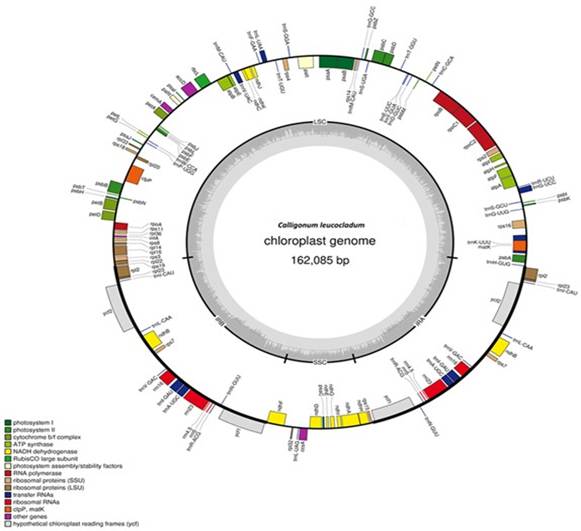
using the OGDRAW online software (Fig. 1) (Fig. S3). The results showed that the chloroplast
genome of this species was circular and 162,085 bp long. This size is within
the normal range for a typical chloroplast genome (usually 120-160 kb), and
when compared to other plant species (for example, Nicotiana tabacum:
155.943 bp; Arabidopsis thaliana: 154.478 bp), it can be said that the
chloroplast genome of this species is larger than average. The chloroplast
genome consists of four parts: a large single-copy region, a small single-copy
region, and two inverted repeat sequences separating the two regions. The IRa
(30.527 bp) and IRb (30.527 bp) regions totalled 61,054 bp; the SSC region was
13,345 bp long, and the LSC region was 87,686 bp long (Table
3). The GC content of the entire chloroplast sequence was 37.5%. The
genome contained 79 protein-coding genes, four rRNA genes, and 29 tRNA genes.
The contents of the genes in the chloroplast genome and the functions of these
genes are shown in (Table S1).
The inverted repeat (IR) regions in the C.
leucocladum chloroplast genome included four rRNA genes (rrn16, rrn23,
rrn4.5, and rrn5), six tRNA genes (trnI-CAU, trnA-UGC, trnI- GAU,
trnR-ACG, trnV-GAC, and trnN-GUU),and seven protein-coding genes (rps7,
rps12, rps19, rpl2, rpl23, ndhB, and ycf2). The large single copy (LSC)
region (~87,000 bp) harbors most of the photosynthesis genes (psaA/B,
psbA-Z, rbcL), ribosomal proteins, and tRNAs with 79 genes, whereas the
small single copy (SSC) region (~13,000 bp) hosts the NADH dehydrogenase
complex genes (ndhA-K) and ycf1. Pseudogene analysis showed that ycf1
(SSC-IR boundary), infA (LSC, translation factor), and rps16
(LSC, exon loss) are dysfunctionalized.
Similar patterns have been documented for other plant
genomes.[29] IRs ensure genome stability, whereas pseudogenes
exhibit evolutionary adaptations. These findings are important for
understanding the spatial distribution and functional diversity of genes.[30]
3.3 Codon usage
Codon usage bias in chloroplast genomes is critical
for evolutionary adaptation, protein synthesis efficiency, and regulation of
gene expression.[31] Differences in chloroplast codon usage
reflect evolutionary processes, energy balance, and environmental adaptations.
These dynamics are influential in a wide range of areas from photosynthetic
capacity to gene engineering strategies.[32] According to codon usage data from the C.
leucocladum chloroplast genome, synonymous codons of some amino acids were
preferred significantly more frequently (Table 2).
For example, the GAU codons for aspartic acid (79.2%),
glutamic acid (73.1%), and lysine (74.0%) were the most frequently used codons,
with RSCU values of 881, 1.082, and 1.131, respectively, showing a clear usage
bias towards synonymous codons. Similarly, dominant codon preferences were
observed for amino acids, such as phenylalanine (UUU, 65.3%; RSCU=1.015),
asparagine (AAU, 77.6%; RSCU=966), isoleucine (AUU, 49.8%; RSCU=1.134),
methionine (AUG, 99.7%; RSCU=1), and tryptophan (UGG, 100%; RSCU=1). In general,
most codons with RSCU values >1 contained A/U (or T) at the third position,
which is consistent with the overall A/T base bias of the genome. tRNA analysis
revealed that the 30 tRNA genes present in the plastid genome corresponded to
all 20 standard amino acids, and that these tRNAs fulfilled codon diversity
with extra copies or flexible recognition capacity for some codons (e.g.,
trnS-GCU, trnS-UGA, and trnS-GGA). This suggests that the chloroplast genome
has evolved to optimize its translational efficiency.[33]
Table 2: Calligonum L. final genome assembly statistics.
|
Sample
|
Number of contigs
|
N50, bp
|
Maximum length, bp
|
Total length, Gbp
|
|
P1
|
5.469.129
|
535
|
65.362
|
2.549
|
|
P2
|
5.449.065
|
1383
|
157.662
|
4.319
|
|
P3
|
4.677.717
|
1092
|
91.349
|
3.117
|
3.4 SSRs analysis
Simple sequence repeats (SSRs) in chloroplast genomes,
that is, microsatellites, are short nucleotide sequences that repeat within
chloroplasts.[34] Cp genome SSRs occur mostly as mononucleotide
(especially A/T-rich) repeats and tend to be concentrated in noncoding regions
(Wang et al., 2013).[35]
Although these repeats show less polymorphism than nuclear genome SSRs, they
are used as valuable molecular markers to elucidate phylogenetic relationships,
distinguish species, analyze population structure, and determine genetic
diversity in plants.[36] A total
of 47 SSRs were detected in the chloroplast genome of C. leucocladum (Table 3).
Table 3: Base composition of the Calligonum L.
chloroplast genome.
|
Region
|
Length
|
A (%)
|
T (U) (%)
|
C (%)
|
G (%)
|
A + T (%)
|
G + C (%)
|
|
LSC
|
87686
|
31.4%
|
32.9%
|
18.2%
|
17.4%
|
64.3%
|
35.6%
|
|
SSC
|
13345
|
34.6%
|
34.4%
|
16.2%
|
14.8%
|
69.0%
|
31.0%
|
|
IR A
|
30527
|
28.3%
|
28.5%
|
22.3%
|
20.8%
|
56.8%
|
43.1%
|
|
IR B
|
30527
|
28.5%
|
28.3%
|
20.8%
|
22.3%
|
56.8%
|
43.1%
|
|
Total
|
162085
|
31.2%
|
31.3%
|
19.1%
|
18.4%
|
62.5%
|
37.5%
|
Most SSRs (89.4%) were mononucleotide repeats, among
which A and T bases were dominant. A total of 42 mononucleotide SSRs were
found, of which 22 were T, 18 were A, and only one was a C base. Dinucleotide
SSRs were very rare (6.4%) and detected in only three samples (two TA and one
AT motif). Interestingly, no trinucleotide SSRs were detected. When the lengths
of the SSRs were analyzed, the shortest repeats consisted of 10 base pairs (e.g.,
(T)10 and (A)10) and the longest of the 15 base pairs (for example, (e.g.,
(A)15 and (T)15). Among the SSRs analyzed, no examples of compound SSRs were
found, and all repeats contained a single motif. These findings reflect the
pronounced AT-bias characteristic of the chloroplast genome and reveal
potential SSR loci that can be used as molecular markers in population genetics
and intraspecific diversity studies of this species.[37] These features of microsatellite
distribution support the mutational bias and microsatellite instability of the
genome.[38] SSR analysis of the chloroplast genome
of C. leucocladum revealed that the mononucleotide repeats were mostly
composed of poly-T (22 samples) and poly-A (18 samples) motifs, with only one
poly-C (C)10 repeat. The dinucleotides consisted entirely of AT/TA motifs
(three samples: (AT)6 and (TA)6), and no GC-containing dinucleotide SSRs were
detected. These findings are in agreement with the AT bias characteristic of
chloroplast genomes and are consistent with the poly-A/poly-T dominance and
AT/TA dinucleotide prevalence reported in previous studies.[39] Compound SSRs were not present in this dataset, and
all SSRs contained a single motif. Most SSRs (25) were localized in intergenic
(non-coding) regions, four were detected in introns and only 3 in coding genes
(rpoC2, atpB, and ycf1). This suggests that chloroplast
SSRs are generally concentrated in regulatory regions and have a potential
impact on gene function.[40]
3.5 Comparative analyses of the chloroplast genome of C.
leucocladum
The cp genomes of C. leucocladum samples
collected from three different locations (P1, P2, and P3) provided interesting
findings reflecting intraspecific variation (Table S1
is provided in the appendix.). The P1 and P2 samples were completely identical
in terms of genome size (162.085 bp), regional length (LSC: 87.686 bp; SSC:
13.345 bp; IR: 61.054 bp), and gene content (112 genes, 79 protein-coding
genes, 29 tRNA, 4 rRNA), indicating genetic stability in the same population.
In contrast, sample P3 was 102 bp longer than the others, with a genome of
162.187 bp, showing structural differences: The LSC region was shorter (83.618
bp), the SSC region was markedly enlarged (17.657 bp), and the IR region was
smaller (51.452 bp). These changes were probably due to shifts in the IR/SSC
boundary.[41]
In addition, the number of genes (126), protein-coding
genes (81), tRNAs (37), and rRNAs (8) was increased in P3. These differences
suggest that P3 undergoes genomic adaptation owing to geographical isolation or
mutational pressures. In conclusion, despite the conserved structure of P1/P2,
variations in P3 emphasize the microevolutionary dynamics of the species and
point to plasticity of the chloroplast genome.[42] The chloroplast genome differences observed in the P3
sample revealed the microevolutionary adaptation processes of this plant
species and the dynamic nature of the chloroplast DNA. The reduction in the IR
region by 9,602 bp and the expansion of the SSC region indicate homologous
recombination events in inverted repeat regions, a common rearrangement
mechanism in chloroplast genomes. The increase in the number of tRNA and rRNA
genes (from 29 to 37 and from 4 to 8, respectively) may be associated with an
increase in translational capacity, reflecting physiological adaptation
developed by the P3 population in response to different environmental
conditions (e.g., soil salinity or drought stress). The slight increase
in protein-coding genes (79 → 81) may be the result of events, such as
horizontal gene transfer or gene duplication. The absence of these changes in
P1/P2 suggests that the P3 population diverged because of geographical
isolation or local selective pressures.[43] These variations prove that the species shows genomic
flexibility even on a short evolutionary time scale, and that the chloroplast
is a dynamic evolutionary unit rather than a static structure.[44] These findings have important
implications, particularly for understanding the molecular responses of plants
to environmental stress.[45]
To compare C. leucocladum specimens collected
from three different locations, we selected two other cp genomes from the NCBI
database from the genus Polygonaceae. For comparative analyses,
chloroplast genome sequences Rheum palmatum (NC_027728) and Fagopyrum
of Rheum palmatum (NC_027728) and Fagopyrum luojishanense
(NC_037706) were included. The sliding window analysis conducted with DnaSP6
software revealed that nucleotide diversity across the five chloroplast genomes
was predominantly localized within the large single-copy (LSC) and small
single-copy (SSC) regions, The observed distribution of polymorphic sites
suggests that evolutionary constraints operate differentially across these
genomic compartments, with the LSC and SSC regions serving as primary reservoirs
of sequence variation in these chloroplast genomes. (Fig.
2).
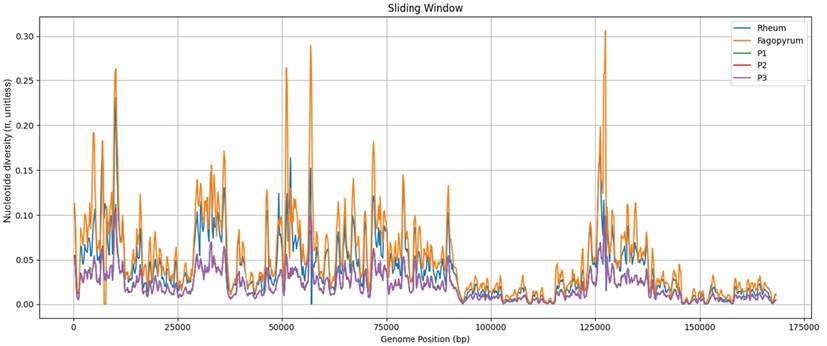
Fig. 2: Sliding window analysis of
five complete chloroplast genomes.
The analysis was performed with a window length of 800
bp and a step size of 200 bp. Rheum – Rheum palmatum; Fagopyrum
– Fagopyrum luojishanense; P1 – Balkhash-Alakul floristic region, Almaty
region, Balkhash district, Taukum sands; P2 – Balkhash-Alakul floristic region,
Almaty region, Balkhash district, Saryesik-Atyrau sands, near Bacanas village;
P3 – Balkhash-Alakul floristic region, Almaty region, Balkhash district,
Saryesik-Atyrau sands, Malaysary locality.
Significantly high π values (in the range of
0.05-0.25) were observed in the LSC (0-75.000 bp) and SSC (125.000-150.000 bp)
regions, while the IR regions (around 75.000-125.000 bp) exhibited almost zero
variation. This distribution confirms that IRs are conserved by homologous
recombination, while LSCs/SSCs are more vulnerable to mutation accumulation.[46] In particular, a ‘hot spot’ reaching
π ≈ 0.25 in the 50,000-60,000 bp range in the Fagopyrum
sample indicates that this region can be used as a phylogenetic marker. The
similar diversity profiles of the P1-P3 samples reflect the intraspecific
genomic stability of C. leucocladum, while the differences in Rheum and
Fagopyrum emphasize interspecific divergence.
We also compared the most conserved region, IR, in the
chloroplast genomes, and then the IR-SSC and IR-LSC sites of the five species (Fig. 3).
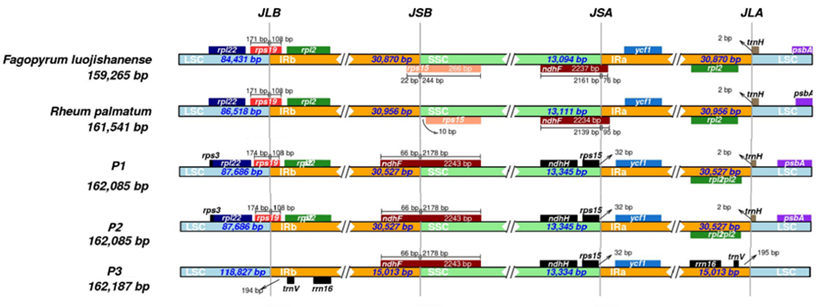
Fig. 3: Comparison of the LSC, SSC, and IR boundary regions
among five Polygonaceae chloroplast genomes.
The figure illustrates the junctions of the large
single-copy (LSC), small single-copy (SSC), and inverted repeat (IR) regions in
Fagopyrum luojishanense, Rheum palmatum, and three Calligonum
leucocladum populations (P1, P2, and P3). Gene positions and lengths are
shown relative to the boundary regions.
IR comparison showed the structural organization of
the chloroplast genomes of species belonging to the Polygonaceae family,
and in particular, the comparative analysis of C. leucocladum samples
(P1, P2, P3) with Fagopyrum luojishanense and Rheum palmatum. The
figure highlights the boundaries and lengths of four major regions of the
chloroplast genome: large single copy (LSC), small single copy (SSC), and
inverted repeat (IRa/IRb) regions. While the genome sizes (162.085 bp) and
regional lengths (LSC: 87.686 bp; SSC: 13.345 bp; IR: 61.054 bp) of Calligonum
specimens P1 and P2 were exactly the same, the shrinkage of the IR region
(51.452 bp) and expansion of the SSC region (17.657 bp) in P3 was striking.
This difference may indicate that P3 underwent genomic adaptation owing to
geographical isolation or environmental stress. The genome sizes of Fagopyrum
luojishanense (159.265 bp) and Rheum palmatum (161.541 bp) were
smaller than those of Calligonum, and the changes in IR-SSC boundaries
reflected evolutionary divergence between the species. While samples P1 and P2
were almost identical, sample P3 exhibited clear structural differences at the
JLB and JSA boundaries. Especially in P3, the IRb and SSC regions were
shortened, genes such as rrn16 and trnV moved to the IR-SSC border, and the ndhF
gene contained a smaller segment. These differences suggest that there are
structural variations at the chloroplast genome level among specimens of C.
leucocladum collected from different geographical locations, and that
intraspecific plastome variation may exist. These structural differences
provide important clues for evolutionary and taxonomic studies.[47] Our results showed that in the P3 sample,
the IRb and SSC regions were markedly shortened. Normally, IR regions are
highly conserved and of fairly constant length; length variation in these
regions is a remarkable event in the structural evolution of the chloroplast
genome. At P3, this shortening caused the IRb region to shift into the SSC, and
genes typically located in the IR region, such as rrn16 and trnV genes, moved
to the IR-SSC boundary. The shift of these genes to the border region indicates
that the boundaries of the IR region have been redefined and structural
rearrangements have occurred in P3 sample. Furthermore, the ndhF gene
contains a shorter segment in P3 than in P1 and P2 samples, suggesting either a
partial deletion in this gene or that the gene is in a split or restricted
state as a result of its proximity to the IR-SSC boundary. Such structural
differences may be indicative of location-dependent plastome reorganization,
and these variations could be interpreted as early signals of intraspecific
phylogeographic divergence, adaptation processes, or intraspecific plastid
genome evolution. In summary, these boundary shifts and changes in gene
structure observed in the P3 sample suggest that there is significant
chloroplast genome plasticity among different geographical populations of C.
leucocladum, and that intraspecific genetic diversity can be monitored not
only at the nuclear level but also at the organelle genome level.[48]
Our plastome-based insights also have direct
agricultural relevance: identifying drought-resilient C. leucocladum
genotypes can enhance pasture stability, optimize windbreak design, and
strengthen agroforestry shelterbelts in arid farming systems.[49] By guiding the selection of locally
adapted lineages, these genomic markers can further support soil-protective
cropping, dune stabilization around farmlands, and reclamation of marginal
agricultural lands. Moreover, linking plastome variation to stress-tolerance
traits opens opportunities to improve forage reliability for camel and goat
husbandry within mixed agro-pastoral systems.[50]
The phylogenetic tree included three specimens (P1,
P2, and P3) of C. leucocladum collected from different locations,
together with the closely related species Fagopyrum luojishanense and Rheum
palmatum (Fig. 4).
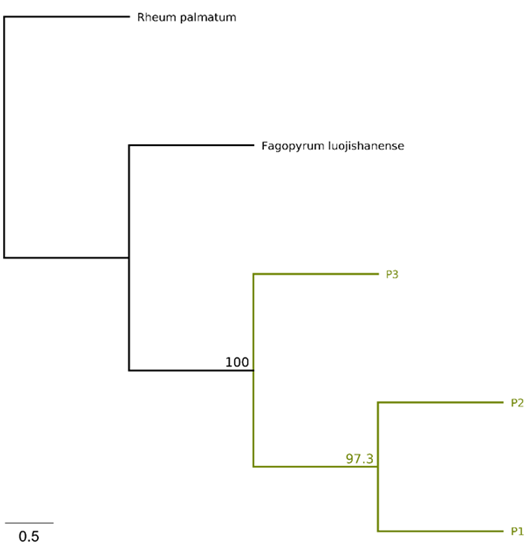
Fig. 4: Phylogenetic tree based on the complete chloroplast
genomes of five species constructed using the maximum likelihood (ML) method.
The Rheum palmatum and Fagopyrum
luojishanense chloroplast genome sequences were used as outgroups.
Bootstrap support values (≥50%) are indicated at the nodes.
In the phylogenetic tree, specimens P1 and P2 were
grouped as the closest relatives with a high support value (97.3%), and these
two specimens later merged with P3 to form an intraspecific clade. This
suggests that genetic differences exist between different geographical
populations of C. leucocladum but that they are evolutionarily closely
related within a common species framework. The entire P1-P2-P3 clade diverged
from Fagopyrum luojishanense with a support value of 100%, and this
clade diverged from the more distant relative Rheum palmatum to form the
outgroup of the tree. In conclusion, this phylogenetic structure demonstrates
that C. leucocladum carries location-based genetic variation within
itself and is clearly distinct from other Polygonaceae members.
The comparative chloroplast genomics of Calligonum
leucocladum from Kazakhstan reveals important molecular adaptations to arid
environments, consistent with recent findings on stress tolerance and
biochemical resilience in other plant taxa. The contraction of the IR and
expansion of the SSC regions in one population suggest genomic plasticity as an
adaptive mechanism to harsh desert conditions, echoing similar
stress-responsive genomic modulations observed in phytoremediation species.[51] The predominance of A/T-rich codon usage
may enhance transcriptional efficiency under oxidative stress, paralleling
mechanisms described for bioactive desert species such as Prosopis.[52] Moreover, studies on Paeonia emodi
and Arctium tomentosum have demonstrated that secondary metabolites
contribute to environmental fitness and pharmacological potential.[53-54] Notably, the regulatory pathways
influenced by compounds like spermidine and calotropin highlight how
small-molecule mediators modulate oxidative and cellular homeostasis,[55-56] offering analogies to chloroplast-level
stress regulation in C. leucocladum. Integrating genomic, biochemical,
and ecological data thus provides a comprehensive framework for understanding
adaptive evolution and advancing the use of C. leucocladum in
sustainable agroforestry and ecological restoration of Kazakhstan’s arid zones.[57-59]
4. Conclusion
We sequenced the full chloroplast genomes of C.
leucocladum samples from different areas (P1, P2, and P3) and then compared
them. The results showed that the chloroplast genome of this species is built
like most plant plastomes, but there are some differences, especially in sample
P3. Samples P1 and P2 were alike in genome size, gene count, and border areas.
However, sample P3 had different structural changes, like a smaller IR region,
a bigger SSC region, and more genes. It seems the P3 group may have changed its
genome to suit specific environmental conditions or because it was cut off
geographically. SSR analysis showed many microsatellite repeats that were
mostly A/T, which could be helpful for creating molecular markers. Looking at
codon usage bias helped us figure out how the species changes to fit its
environment by controlling gene expression and translation. The structural
changes we saw give useful info for studies about evolution and taxonomy, and
they show that C. leucocladum can change its genes on the plastome
level. This identified genomic plasticity, particularly the adaptive changes in
P3, provides a foundation for developing molecular markers to select
stress-tolerant genotypes, thereby supporting agroforestry growth, soil
protection cropping, and ecological restoration of degraded agricultural lands
in Central Asia. This study is being carried out within the framework of grant
project AP26100259, funded by the Science Committee of the Ministry of Science
and Higher Education of the Republic of Kazakhstan, SZU Top Ranking Project
“B&RsacFMS”[868/0000080208] and the work is currently ongoing.
Acknowledgments
We would like to express our deepest appreciation to
Science Committee of the Ministry of Science and Higher Education of the
Republic of Kazakhstan
Conflict of Interest
There is no conflict of interest.
Supporting Information
Applicable.
CRediT Statement
Bekzat Tynybekov: Data curation, Data
validation, Supervision, Writing - Review & editing, and Funding acquisition. Мaral Mussina: Methodology, Investigation,
Writing
- Original
draft, and Writing - Review & editing. Elzira
Kyrbassova: Methodology, Conceptualization, and Funding
acquisition. Alibek Ydyrys: Visualization, and Data curation. Wenya Hou: Formal
analysis. Zhandos Bassygarayev: Methodology, Resources
and Validation. Alikhan Bozhbanov: Investigation and Data
curation. Elmira
Imаnova: Methodology, Visualization, Software,
Moldir Imanaliyeva: Review & editing. Ussen
Kurmanbay: Conceptualization, Resources and Validation.
References
[1] S. Asaf, A. L. Khan, A. R. Khan, M.
Waqas, S.-M. Kang, M. A. Khan, S.-M. Lee, I.-J. Lee, Complete chloroplast
genome of nicotiana Otophora and its comparison with related species, Frontiers in Plant Science, 2016, 7, 843,
doi: 10.3389/fpls.2016.00843.
[2] A. M. Bolger, M. Lohse, B. Usadel,
Trimmomatic: a flexible trimmer for Illumina sequence data, Bioinformatics, 2014, 30, 2114-2120, doi:
10.1093/bioinformatics/btu170.
[3] M. Ceccarelli, V. Sarri, M. E. Caceres,
P. G. Cionini, Intraspecific genotypic diversity in plants, Genome, 2011, 54, 701-709, doi:
10.1139/g11-039.
[4] H. Dang, T. Zhang, Y. Li, G. Li, L.
Zhuang, X. Pu, Population evolution, genetic diversity and structure of the
medicinal legume, glycyrrhiza uralensis and the effects of geographical
distribution on leaves nutrient elements and photosynthesis, Frontiers in Plant Science, 2022, 12,
708709, doi: 10.3389/fpls.2021.708709.
[5] H. Daniell, C.-S. Lin, M. Yu, W.-J.
Chang, Chloroplast genomes: diversity, evolution, and applications in genetic
engineering, Genome Biology, 2016, 17,
134, doi: 10.1186/s13059-016-1004-2.
[6] P. G. D. Feulner, R. De-Kayne, Genome
evolution, structural rearrangements and speciation, Journal of Evolutionary Biology, 2017, 30, 1488-1490,
doi: 10.1111/jeb.13101.
[7] Frazer, K. A., Lior, P.,
Alexander, P., Rubin, E. M., & Inna, D. VISTA: computational tools for
comparative genomics, Nucleic Acids Research, 2004, W273–W279.
[8] B. George, B. S. Bhatt, M. Awasthi, B.
George, A. K. Singh, Comparative analysis of microsatellites in chloroplast
genomes of lower and higher plants, Current
Genetics, 2015, 61, 665-677, doi: 10.1007/s00294-015-0495-9.
[9] Y.-Y. Guo, J.-X. Yang, M.-Z. Bai, G.-Q.
Zhang, Z.-J. Liu, The chloroplast genome evolution of Venus slipper
(Paphiopedilum): IR expansion, SSC contraction, and highly rearranged SSC
regions, BMC Plant Biology, 2021, 21,
248, doi: 10.1186/s12870-021-03053-y.
[10] P. E. Jensen, D. Leister, Chloroplast
evolution, structure and functions, F1000Prime
Reports, 2014, 6, doi: 10.12703/p6-40.
[11] K. Katoh, J. Rozewicki, K. D. Yamada,
MAFFT online service: multiple sequence alignment, interactive sequence choice
and visualization, Briefings in Bioinformatics,
2019, 20, 1160-1166, doi: 10.1093/bib/bbx108.
[12] D.-Y. Kuang, H. Wu, Y.-L. Wang, L.-M.
Gao, S.-Z. Zhang, L. Lu, Complete chloroplast genome sequence of Magnolia
kWangsiensis (Magnoliaceae): implication for DNA barcoding and population
genetics, Genome, 2011, 54,
663-673, doi: 10.1139/g11-026.
[13] K.-C. Kwon, H.-T. Chan, I. R. León, R.
Williams-Carrier, A. Barkan, H. Daniell, Codon optimization to enhance
expression yields insights into chloroplast translation, Plant Physiology, 2016, 172, 62-77, doi:
10.1104/pp.16.00981.
[14] Li, J., Wang, S., Yu, J.,
Wang, L., & Zhou, S. A modified CTAB protocol for plant DNA extraction, Chinese Bulletin of Botany, 2013, doi:
10.3724/SP.J.1259.2013.00072.
[15] Y.-C. Li, A. B. Korol, T. Fahima, A.
Beiles, E. Nevo, Microsatellites: genomic distribution, putative functions and
mutational mechanisms: a review, Molecular Ecology,
2002, 11, 2453-2465, doi: 10.1046/j.1365-294X.2002.01643.x.
[16] Liu, J., Yan, H. F.,
Newmaster, S. G., Pei, N., & Ge, X. J. The use of DNA barcoding as a tool
for the conservation biogeography of subtropical forests in China, Diversity and Distributions, 2015, 21, 188–199.
[17] Liu, Y. X. Flora in desertis reipublicae
populorum sinarum, 1985, Science Press, Bejijing China.
[18] M. Lohse, O. Drechsel, R. Bock,
OrganellarGenomeDRAW (OGDRAW): a tool for the easy generation of high-quality
custom graphical maps of plastid and mitochondrial genomes, Current Genetics, 2007, 52, 267-274, doi:
10.1007/s00294-007-0161-y.
[19] Q. P. Ma, C. Li, J. Wang, Y. Wang, Z.
T. Ding, Analysis of synonymous codon usage in FAD7 genes from different plant
species, Genetics and Molecular Research,
2015, 14, 1414-1422, doi: 10.4238/2015.february.13.20.
[20] Mao, Z. M., & Pan, B.
R, SSThe classification and distribution of the genus Calligonum L. in China, Acta Phytotaxonomica Sinica, 1986, 24, 98–107.
[21] H. Morgil, O. Unlu, K.
Boztas, I. Tulum, G. Oz, Comparative analysis of the complete chloroplast
genome of endemic Colchicum baytopiorum CD. BRICKELL, Brazilian Journal of Botany, 2024, 47, 637-647,
doi: 10.1007/s40415-024-01021-y.
[22] E. J. Oliveira, J. G. Pádua, M. I.
Zucchi, R. Vencovsky, M. L. C. Vieira, Origin, evolution and genome
distribution of microsatellites, Genetics and
Molecular Biology, 2006, 29, 294-307, doi:
10.1590/s1415-47572006000200018.
[23] L. Orsini, J. Vanoverbeke, I. Swillen,
J. Mergeay, L. De Meester, Drivers of population genetic differentiation in the
wild: isolation by dispersal limitation, isolation by adaptation and isolation
by colonization, Molecular Ecology,
2013, 22, 5983-5999, doi: 10.1111/mec.12561.
[24] S. T. Parvathy, V. Udayasuriyan, V.
Bhadana, Codon usage bias, Molecular Biology
Reports, 2022, 49, 539-565, doi: 10.1007/s11033-021-06749-4.
[25] Rice, K. J., & Emery,
N. C. Managing microevolution: restoration in the face of global change, Frontiers in Ecology and the
Environment,
2003, 1, 469–478.
[26] A. Sanchez, T. M. Schuster, J. M.
Burke, K. A. Kron, Taxonomy of polygonoideae (Polygonaceae): a new tribal
classification, TAXON, 2011, 60,
151-160, doi: 10.1002/tax.601013.
[27] S. Beier, T. Thiel, T. Münch, U.
Scholz, M. Mascher, MISA-web: a web server for microsatellite prediction, Bioinformatics, 2017, 33, 2583-2585, doi:
10.1093/bioinformatics/btx198.
[28] F. Song, T. Li, K. S. Burgess, Y.
Feng, X.-J. Ge, Complete plastome sequencing resolves taxonomic relationships
among species of Calligonum L. (Polygonaceae) in China, BMC Plant Biology, 2020, 20, 261, doi:
10.1186/s12870-020-02466-5.
[29] Stefan, K., Choudhuri, J. V.,
Enno, O., Chris, S., Jens, S., & Robert, G. REPuter: the manifold
applications of repeat analysis on a genomic scale, Nucleic Acids Research, 2001, 29, 4633–4642.
[30] K. Tamura, G. Stecher, D. Peterson, A.
Filipski, S. Kumar, MEGA6: molecular evolutionary genetics analysis version
6.0, Molecular Biology and Evolution,
2013, 30, 2725-2729, doi: 10.1093/molbev/mst197.
[31] J. Wang, S. Kan, J. Kong, L. Nie, W.
Fan, Y. Ren, W. Reeve, J. P. Mower, Z. Wu, Accumulation of large
lineage-specific repeats coincides with sequence acceleration and structural
rearrangement in Plantago plastomes, Genome
Biology and Evolution, 2024, 16, evae177, doi:
10.1093/gbe/evae177.
[32] S. Wang, C. Shi, L.-Z. Gao, Plastid
genome sequence of a wild woody oil species, prinsepia utilis, provides
insights into evolutionary and mutational patterns of Rosaceae chloroplast
genomes, PLoS One, 2013, 8,
e73946, doi: 10.1371/journal.pone.0073946.
[33] G. L. Wheeler, H. E. Dorman, A.
Buchanan, L. Challagundla, L. E. Wallace, A review of the prevalence, utility,
and caveats of using chloroplast simple sequence repeats for studies of plant
biology, Applications in Plant Sciences,
2014, 2, 1400059, doi: 10.3732/apps.1400059.
[34] S. M. Vamosi, S. B. Heard, J. C.
Vamosi, C. O. Webb, Emerging patterns in the comparative analysis of
phylogenetic community structure, Molecular Ecology,
2009, 18, 572-592, doi: 10.1111/j.1365-294X.2008.04001.x.
[35] Zhang, Y., Zhang, A., Li,
X., & Lu, C. The role of chloroplast gene expression in plant responses to
environmental stress, International Journal of Molecular Sciences, 2020, 21, 6082.
[36] C. Zhao, Y. Wang, K. X. Chan, D. B.
Marchant, P. J. Franks, D. Randall, E. E. Tee, G. Chen, S. Ramesh, S. Y. Phua,
B. Zhang, A. Hills, F. Dai, D. Xue, M. Gilliham, S. Tyerman, E. Nevo, F. Wu, G.
Zhang, G. K. S. Wong, J. H. Leebens-Mack, M. Melkonian, M. R. Blatt, P. S.
Soltis, D. E. Soltis, B. J. Pogson, Z.-H. Chen, Evolution of chloroplast
retrograde signaling facilitates green plant adaptation to land, Proceedings of the National Academy of Sciences of the
United States of America, 2019, 116, 5015-5020, doi:
10.1073/pnas.1812092116.
[37] Bunge, A. Generis Calligoni species. St. Petersburg: Typis
Academiae Scientiarum, 1879.
[38] Grubov, V. I. Opredelite rasteniy Sredney Azii, Leningrad: Nauka, 1966.
[39] Pavlov, N. V. (Ed.). Flora Kazakhstana, Alma-Ata: Izdatel’stvo
AN KazSSR, 1961,
Almaty, Kazakhstan.
[40] Flora of Kazakhstan Alma-Ata: Izdatel’stvo
AN KazSSR, 1963.
[41] Bao, B. J., &
Grabovskaya-Borodina, A. E. Calligonum. In Wu, Z. Y. & Raven, P. H. (Eds.), Flora of China, 2003, 5, 331–339.
[42] Nabiev, M. M. Flora Tadzhikskoy SSR, Dushanbe, Donish 1985.
[43] Kamelin, R. V. Conspectus florae Asiae Mediae.
St. Petersburg, SpbU
Press, 2004, 11.
[44] Makhmedov, A. M. The
vegetation of sandy deserts of Central Asia and its degradation, Arid Ecosystems, 1998, 4, 45–53.
[45] Wang, J., Li, W., &
Zhang, Y. Photosynthetic and antioxidant responses of C. leucocladum to prolonged drought, Journal of Arid Land, 2020, 12, 78–89.
[46] Yuan, C., Xu, H., &
Li, W. Role of desert shrubs in stabilizing sand dunes in Central Asia, Environmental Earth Sciences, 2016, 75, 1143.
[47] Plants of the World Online
(POWO). C.
leucocladum,
http://www.plantsoftheworldonline.org, 2025.
[48] World Flora Online (WFO). C. leucocladum,
http://www.worldfloraonline.org, 2025.
[49] Imanaliyeva, M.,
Kurmanbay, U., Mamytova, N., Kilybayeva, T., Toktar, M., Adenova, B.,
Childibayeva, A. The soils of natural populations of Gentiana tianschanica
Rupr.(Gentianaceae) in Ile Alatau, Kazakhstan, EQA-International Journal of Environmental
Quality, 2025, 69, 62-72, doi: 10.6092/issn.2281-4485/20950.
[50] Zhang, Y., Li, X., &
Wang, J. Agroforestry strategies for desert ecosystem restoration in Central
Asia, Land
Degradation & Development, 2021, 32, 2241–2253, doi: 10.1002/ldr.3845.
[51] G. Rahman, J. Muhammad, M. Ilyas, M.
Subhanullah, K. Ullah, M. Massimzhan, M. Toktar, Y. Bektay, M. Kalybekov, A.
Ydyrys, Y. Zhakypbek, Phytoremediation of heavy metals from soil and their
effects on plant physiology - a review, ES
Materials & Manufacturing, 2024, 26, 1298, doi:
10.30919/esmm1298.
[52] J. Sharifi-Rad, N. El Menyiy, A. Ydyrys,
N. El Hachlafi, N. El Omari, A. A. Aldahish, F. Sharopov, A. Bouyahya, J.
Živković, C. O. Adetunji, O. T. Olaniyan, M. Martorell, E. Sönmez Gürer,
C. Hano, D. Calina, Bioactive compounds from Prosopis species as potential
oxidative stress and inflammation modulators: an update on mechanisms, Minerva Biotechnology and Biomolecular Research,
2023, 35, doi: 10.23736/s2724-542x.23.02977-2.
[53] N. Zahra, J. Iqbal, M. Arif, B. A.
Abbasi, H. Sher, A. F. Nawaz, T. Yaseen, A. Ydyrys, J. Sharifi-Rad, D. Calina,
A comprehensive review on traditional uses, phytochemistry and pharmacological
properties of Paeonia emodi Wall. ex Royle: current landscape and future
perspectives, Chinese Medicine, 2023, 18,
23, doi: 10.1186/s13020-023-00727-7.
[54] A. Ydyrys, An Overview of Medical uses
and Chemical Composition of Arctium tomentosum mill, Engineered Science, 2023, 26, 984, doi: 10.30919/es984.
[55] P. Prasher, M. Sharma, S. K. Singh, M.
Gulati, D. K. Chellappan, R. Rajput, G. Gupta, A. Ydyrys, M. Kulbayeva, A. F.
Abdull Razis, B. Modu, J. Sharifi-Rad, K. Dua, Spermidine as a promising
anticancer agent: Recent advances and newer insights on its molecular
mechanisms, Frontiers in Chemistry,
2023, 11, 1164477, doi: 10.3389/fchem.2023.1164477.
[56] J. Rajkovic, R. Novakovic, J.
Grujic-Milanovic, A. Ydyrys, N. Ablaikhanova, D. Calina, J. Sharifi-Rad, B.
Al-Omari, An updated pharmacological insight into calotropin as a potential
therapeutic agent in cancer, Frontiers in
Pharmacology, 2023, 14, 1160616, doi:
10.3389/fphar.2023.1160616.
[57] M. Imanaliyeva, E. Kyrbassova, A.
Aksoy, A. U. A. Turkey, M. C. Vardar, A. U. A. Turkey, G. Sadyrova, M.
Parmanbekova, S. Issabayeva, B. Yeszhanov, A. Ametov, Y. Satekov, Z. Askarova,
G. Srailova, A. Ydyrys, B. Tynybekov, Ecological monitoring of G. olivieri
Griseb populations, a medicinal and food plant, ES
Food & Agroforestry, 2024, 17, 1245, doi:
10.30919/esfaf1245.
[58] A. Ydyrys, N. Mukhitdinov, A.
Ivashchenko, Z. Ashirova, M. Massimzhan, E. Imаnova, M. Parmanbekova, M.
Toktar, B. Yeszhanov, M. Ilesbek, G. Askerbay, R. Kaparbay, Methodological
guide for geobotanical research on rare, endemic, and medicinal plants: a case study
of the Ranunculaceae family, ES Food &
Agroforestry, 2024, 18, 1340, doi: 10.30919/esfaf1340.
[59] М. Mussina, B. Tynybekov, B.
Raimbekova, A. Orazbayev, A. Iskakova, B. Osmonali, M. Ilyas, S. Issabayeva, A.
Childibayeva, M. Imanaliyeva, Assessment of vegetation and soil characteristics
of calligonum leucocladum populations in the balkhash region, Kazakhstan, ES Energy & Environment, 2025, 30,
1809, doi: 10.30919/ee1809.
Publisher’s
Note: Engineered
Science Publisher remains neutral with regard to jurisdictional claims in
published maps and institutional affiliations.
Open
Access
This
article is licensed under a Creative Commons Attribution 4.0 International
License, which permits the use, sharing, adaptation, distribution and
reproduction in any medium or format, as long as appropriate credit to the
original author(s) and the source is given by providing a link to the Creative
Commons license and changes need to be indicated if there are any. The images
or other third-party material in this article are included in the article's
Creative Commons license, unless indicated otherwise in a credit line to the
material. If material is not included in the article's Creative Commons license
and your intended use is not permitted by statutory regulation or exceeds the
permitted use, you will need to obtain permission directly from the copyright
holder. To view a copy of this license, visit http://creativecommons.org/
licenses/by/4.0/.
©The Author(s) 2025.