A
Green Chemistry Approach towards Synthesis of Bis-coumarins Catalyzed by Different
Biocatalysts such as Dragon Fruit Juice, Kiwi Fruit Juice, and Buttermilk Separately
by Grind Stone Technique:A Comparative Study
Y.
I. Shaikh,1,* V. S. Shaikh,1 G.
M. Nazeruddin,1 Zamir Shekh,2 G. S. Gugale,3
N. R. Prasad4 and Vijay A. Kadnor5
1 Dept. of Chemistry, Abeda Inamdar Senior
College, S.P.P.U, Pune, Maharashtra, India.
2 Dept. of Chemistry,
Shri Shivaji College, Akola, Maharashtra,
India.
3 Haribhai V. Desai College, S.P.P.U, Pune, Maharashtra, India.
4 School of Nano
Science and Technology, Shivaji University, Kolhapur, Maharashtra, India 416004.
5 Department of
Chemistry, Arts Commerce and Science College Satral. Rahuri, Ahmednagar. Maharashtra
*Email: sheray2k@gmail.com (Y. I. Shaikh)
We would like to
report the synthesis of derivatives of bis-coumarin. This was accomplished by
grinding 20 mmol of 4-hydroxy coumarin with 10 mmol of various aromatic
aldehydes in the presence of various biocatalysts such as dragon fruit juice (Hylocereus undatus, the white-fleshed
Pitahaya), kiwi fruit juice (Actinidia deliciosa) and buttermilk in
aqueous medium for 10 to 15 minutes at ambient conditions. The crude product was obtained by filtration and
recrystallized by ethanol. This protocol is a greener approach for organic
transformations, thus facilitating the efficient synthesis of bioactive
compounds in an environmentally benign way with shorter reaction time, mild
reaction conditions, nonhazardous easy workup, and an excellent product yield.
This comparative study reveals that rather than fruit juice or buttermilk, the
acidic nature of an aqueous medium plays a dominating role in speeding up the
reaction. Further, it is also observed that there is not much effect on the
yields of the product by using different biocatalysts.
Table of
Contents

Keywords: Green chemistry; Dragon fruit (Hylocereus
undatus); Kiwi fruit (Actinidia deliciosa); Buttermilk;
Grinding; Bis-coumarin.
1. Introduction
The concept of “Green Chemistry”[1] has been widely
adopted to meet the fundamental scientific challenges of protecting human
health and the environment while simultaneously achieving commercial viability.
One of the thrust areas for achieving this target is to explore an aqueous
reaction medium to accomplish the desired chemical transformation and eliminate
the use of organic solvents.[2] Multicomponent reactions
(MCRs) can provide products with the diversity needed to discover new compounds
using simple and nonhazardous process.[3-5] Chemists have
successfully adopted multicomponent reactions to synthesize an extensive
library of biologically active molecules. The multicomponent reactions are
among the essential protocols in organic synthesis and medicinal chemistry.[6] These unique characteristics
of the multicomponent reaction have attracted the attention of organic
chemists.
The role of naturally available
fruit juice in organic synthesis has attracted the interest of chemists,
particularly from the view of green chemistry. Several organic reactions using
natural catalysts such as clay,[7-8] natural phosphates,[9-11] animal bone,[12] and various fruit juices are reported in the literature.
Due to the acidic nature of aqueous fruit juices like lemon,[13-18] Ananas comosus (pineapple),[19-20] Cocos nucifera
(Coconut),[21] Acacia concinna,[22] Sapindus trifolistus,[23] and Tamarindus indica[24] fruit are a suitable replacement for various homogeneous
acid catalysts. In recent years, research in organic chemistry
is mainly focused on developing methods which are greener and eco-friendly to
replace toxic and expensive catalysts or hazardous solvents like benzene,
toluene, and methanol, which are commonly used in organic synthesis. Nowadays,
many organic transformations have been carried out in water.[25-27] Water is a unique
solvent because it is readily available, inexpensive, non-toxic, safer, and
environmentally benign. The use of water as a reaction medium is inexpensive
and environmentally benign and provides utterly different reactivity.[28] The applications of
an aqueous extract of different fruit juices have witnessed rapid development.
This growing interest in fruit juice is mainly because they are biocatalysts,
environmentally benign, and cost-effective. In the present work, we have used a
simple, efficient, and eco-friendly approach to synthesize bis-coumarin
derivatives. Coumarin derivatives have a wide range of
therapeutic applications such as photo-chemotherapy, anti-tumor, anti-HIV (Human Immuno-deficiency Virus) therapy,
central nervous systems stimulant, antibacterials,
anti-inflammatory, anti-coagulants, and dyes.[29-37] The synthesis of
bis-coumarin was accomplished by grinding the aromatic aldehyde and 4-hydroxy
coumarin with kiwi/dragon fruit juice and buttermilk as a natural catalyst
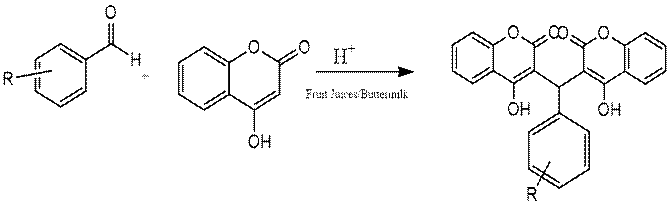
separately. The reaction is depicted in Scheme I.
Materials and methods
All melting points were measured in open capillary and
are uncorrected. IR spectra were recorded using the JASCO FT-IR-4100
instrument. 1H NMR was recorded on the Bruker MSL-300 instrument
using CDCl3 (deuterated chloroform) as
the solvent and TMS (tetramethylsilane) as an
internal standard. All reagents were purchased from Merck and Loba and were used without further purification.
2. Experimental
2.1 Preparation of aqueous extract of kiwi/dragon fruit
juice and buttermilk
The kiwi/dragon fruits were purchased from the local
market. After cutting them into small pieces, 10 g of each fruit was crushed in
50 mL water using a grinder, and was centrifuged using
a microcentrifuge (REMI RM-12C). The transparent portion of the aqueous extract
of the fruit was used as the catalyst for the reaction separately. The
buttermilk was purchased from the local market and was used as the catalyst.
2.2 A general method for the preparation of bis-coumarin
derivatives
The mixture of 10 mmol of an aromatic aldehyde, 20 mmol
of 4-hydroxy coumarin, 5 mL kiwi/dragon fruit juice, and 2.5 mL buttermilk was
grinded mortar pestle separately at the ambient conditions monitoring by thin layer
chromatography (TLC). After completion of the reaction, the reaction mixture
was poured over about 100 g of crushed ice. The crude solid product was
obtained by filtration and purified by crystallization with ethanol. Even
though the catalysts were different, the products obtained from the same
reaction were mixed, and their identity was confirmed by melting points and
spectral data such as IR and 1HNMR.
3. Results and discussion
The synthesis of bis-coumarin was accomplished by
reaction between 4-hydroxy coumarin and substituted benzaldehyde using natural
biocatalyst, an efficient and environmentally friendly catalyst. The probable
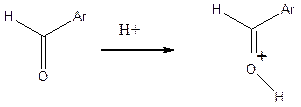
mechanism of the reaction is depicted in Scheme 2.
It is observed that there is no remarkable difference on the yield of the
product by using different biocatalysts. The results are presented in Table 1. Further, the comparative study reveals that
rather than fruit juices or buttermilk, the acidic nature of an aqueous medium
plays a dominating role in accelerating the reaction. The reaction was
accomplished by the green chemistry approach, shorter reaction time, mild
reaction conditions, and easy workup procedure, along with excellent yield.
Compared to other catalysts reported in the literature,[38-39] this is a mild
and highly selective transformation and synthesis in a facile and
environmentally benign manner. Moreover, the fruit juice/buttermilk are
inexpensive and readily available. Furthermore, this protocol is a general
methodology because it accommodates comfortably with the electron-withdrawing
and electron-donating groups in the substrate.
The reaction is initiated by
protonation of an aldehyde followed by reaction of this protonated product with
bis-coumarin, which lands up finally to yield the corresponding bis-coumarin.

Scheme 1. Synthesis of bis-coumarins (Fruit juices: dragon fruit, kiwi fruit) (Where
R = Phenyl,4-nitro phenyl,4-hydroxy phenyl, 4- chlorophenyl,4-methoxy phenyl).


Scheme 2. A probable reaction mechanism of the synthesis.
Table 1. Data of bis-coumarin derivatives obtained by condensing kiwi/dragon fruit juice/buttermilk
catalyzed synthesis of
bis-coumarins obtained by condensing 4-hydroxy coumarin and an aromatic
aldehyde with 2:1 ratio in aqueous medium at ambient conditions just by
grinding.
|
Entry |
R |
Yield % |
Mixed M.P. (observed) °C |
M.P. (reported) °C |
||
|
Kiwi fruit |
Dragon fruit |
Buttermilk |
||||
|
3-a |
H |
80 |
80 |
85 |
226-227 |
228-230[40] |
|
3-b |
4-NO2 |
85 |
87 |
90 |
232-233 |
232-234[41] |
|
3-c |
4-OH |
80 |
80 |
82 |
224-225 |
222-225[40] |
|
3-d |
4-Cl |
82 |
84 |
88 |
253-255 |
252-254[42] |
|
3-e |
4-MeO |
78 |
80 |
82 |
247-248 |
248-249[43] |
The structures of the products were confirmed by
comparing their *mixed M.P. (melting point within a
mixed range) of the product obtained from the reaction using different bio-catalyst and spectral data with authentic samples.
4. Spectral data
(3a)
3-((phenyl)(4-hydroxy-2-oxo-2H-chromen-3-yl)methyl)-4-hydroxy-2H-chromen-2-one
M.P.: 226-227 °C; IR (KBr) 3057, 1676, 1608, 1568, 1492,
1350, 759 cm-1; 1H NMR (CDCl3):
δ (ppm) = 11.53 (s, 1H, OH), 11.32 (s,1H, OH), 8.09-7.24 (m, 13H,
13×CH), 6.11 (s, 1H, CH);
(3b) 3-((4-nitro-phenyl)(4-hydroxy-2-oxo-2H-chromen-3-yl)methyl)-4-hydroxy-2H-chromen-2-one). M.P.: 232-233 °C; IR (KBr) 3080, 1660, 1616, 1600, 1566, 1518, 1450, 1348,
765 cm-1; 1H NMR (CDCl3):
δ (ppm) = 11.57(s, 1H, OH), 11.37(s, 1H, OH), 8.22-7.26 (m, 12H, 12×CH),
6.13 (s, 1H, CH);
(3c)
3-((4-hydroxy-phenyl)(4-hydroxy-2-oxo-2H-chromen-3-yl)methyl)-4-hydroxy-2H-chromen-2-one M.P.: 224-225 °C; IR (KBr) 3452, 3072, 1668, 1608, 1566, 1514, 1433,
1348, 1307, 763 cm-1; 1H NMR (CDCl3): δ
(ppm) = 11.49 (s, 1H, OH), 11.29 (s, 1H, OH), 8.05-6.77 (m, 12H, 12×CH), 6.04 (s,
1H, CH), 3.73 (q, 3H, OH);
(3d) 3-((4-chloro-phenyl)(4-hydroxy-2-oxo-2H-chromen-3-yl)methyl)-4-hydroxy-2H-chromen-2-one M.P.: 253-255 °C; IR (KBr) 3076, 1668, 1602, 1566, 1491, 1450, 1350,
1270, 1215, 767 cm-1; 1H NMR (CDCl3): δ
(ppm) =11.54 (s, 1H, OH), 11.32 (s, 1H, OH), 8.09-7.17 (m, 12H, 12×CH), 6.04 (s,
1H, CH);
(3e)
3-((4-methoxy-phenyl)(4-hydroxy-2-oxo-2H-chromen-3-yl)methyl)-4-hydroxy-2H-chromen-2-one M.P.: 247-248 °C; IR (KBr) 3070, 3001, 1668, 1604, 1466, 1510, 1452,
1352, 1309, 1259, 769 cm-1; 1H NMR (CDCl3): δ
(ppm) =11.5 (s, 1H, OH), 11.29 (s, 1H, OH), 8.05-6.87 (m, 12H, 12×CH), 6.05 (s,
1H, CH), 3.80 (s, 3H, CH3O).
5. Conclusion
Coumarin derivatives have many therapeutic applications
such as photo-chemotherapy, anti-tumor, anti-HIV therapy, central nervous systems
stimulation, antibacterial, anti-inflammatory, anti-coagulation, and dyes. This
broad spectrum of applications makes coumarin an essential constituent for
pharmaceutical applications. Our green approach of one-pot synthesis of
bis-coumarin is a convenient and facile approach for organic transformations,
thus facilitating the efficient synthesis of bioactive compounds in an
environmentally benign way with shorter reaction time, mild reaction
conditions, and easy workup with an excellent yield of the product. However, a
comparative study reveals that by using different bio-catalysts,
there is not much difference in the yield of the product. Further, it is
observed that rather than fruit juices or buttermilk, the acidic nature of the
aqueous medium plays a dominating role in speeding up the reaction.
Conflict of interest
There are no
conflicts to declare.
Supporting information
Not applicable.
References
[1] B. A. de Marco, B. S. Rechelo,
E. G. Tótoli, A. C. Kogawa
and H. R. N. Salgado, Saudi Pharm. J.,
2019, 27, 1-8, doi:
10.1016/j.jsps.2018.07.011.
[2] J. A. Darr and M. Poliakoff, Chem. Rev.,
1999, 99, 495-542, doi: 10.1021/cr970036i.
[3] J. D. Sunderhaus and S. F.
Martin, Chemistry, 2009, 15,
1300-1308, doi: 10.1002/chem.200802140.
[4] S. L. Schreiber, Science, 2000, 287,
1964-9. doi: 10.1126/science.287.5460.1964.
[5] X. Gao, X. Cai, K K. Yan, B. Song, L. Gao and
C. Zhuo, Molecules, 2007, 12, 2621-42, doi: 10.3390/12122621.
[7] S. Achatz and A. Domling,
Bioorg. Med. Chem. Lett.,
2006, 16, 6360-6362, doi:
10.1016/j.bmcl.2006.07.017.
[8] R. Ekambaram and R.
Raghunathan, Synth. Commun.,
2009, 39, 613-625, doi: 10.1080/00397910802417825.
[9] G. Nagendrappa,
Appl. Clay Sci., 2011, 53, 106-138,
doi:
10.1016/j.clay.2010.09.016.
[10] A. Amini, A. Fallah, A. Sedaghat, A. Gholami, C. Cheng and A. R. Gupta, Int. J. Mol. Sci., 2021, 22,
13665, doi: 10.3390/ijms222413665.
[11] G. M. Nazeruddin, S. S. Mulani, Y. I. Shaikh, S. S. Shaikh
and K. Ahmed, IJSRST173910,
2017, 3, 46-50, ISSN: 2395-602X.
[12] S. Sebti, A. Smahi and A. Solly, Tetrahedron
Lett., 2002, 43, 1813-1815, doi:10.1016/S0040-4039(02)00092-8.
[13] Y. Riadi, R. Mamouni, R. Azzalou, R. Boulahjar, Y. Abrouki, M. E.
Haddad, S. Routier, G. Guillaumet
and S. Lazar, Tetrahedron Lett., 2010, 51,
6715-6717, doi: 10.1016/j.tetlet.2010.10.056.
[14] M. B. Deshmukh, S. S. Patil, S. D. Jadhav and P. B.
Pawar, Synth. Commun.,
2012, 42, 1177-1183, doi: 10.1080/00397911.2010.537423.
[15] G. M. Nazeruddin, S. S. Mulani, Y. I. Shaikh, S. B. Suryawashi
and K. Ahmed, Int. J. Curr.
Pharm. Res., 2019, 9, 3020-3024, doi:
10.33786/JCPR.2019.v09i03.002.
[16] S. Patil, S. Jadhav, M. Deshmukh and U. Patil, J. Chem. Sci., 2013, 125, 851-857, doi: 10.1007/s12039-013-0443-5.
[17] R. Pal and T. Sarkar, Int.
J. Org. Chem., 2014, 4, 106-115, doi:
10.4236/ijoc.2014.42012.
[18] R. Pal, IOSR J. Appl. Chem.,
2013, 3, 1-8, doi: 10.9790/5736-0340108.
[19] R. Pal, Int. J. Org. Chem.,
2013, 3, 136-142, doi: 10.4236/ijoc.2013.32015.
[20] S. Patil, S. D. Jadhav and S. Mane, Int. J. Org. Chem., 2011, 1, 125-131, doi: 10.4236/ijoc.2011.13019.
[21] S. Patil, S. D. Jadhav and M. B. Deshmukh, Indian J. Chem., 2013, 52, 1172-1175.
[22] A. M. Fonseca, F. J. Monte, M. C. F. Oliveira, M. C. M.
Mattos, G. A. Cordell, R. Braz-Filho and T. L. G. Lemos, J. Mol. Catal B-Enzym., 2009, 57,
78-82, doi: 10.1016/j.molcatb.2008.06.022.
[23] S. Pore, G. Rashimkar, K. Mote,
and R. Salunkhe, Chem. Biodivers., 2010, 7, 1796-1800, doi: 10.1002/cbdv.200900272.
[24] S. Pore, G. Rashimkar, K.
Mote and R. Salunkhe, Chem.
Biodivers, 2010, 7, 1796-1800, doi: 10.1002/cbdv.200900272.
[25] R. Pal and T. Sarkar, Int.
J. Org. Chem., 2014, 4, 106-115, doi:
10.4236/ijoc.2014.42012.
[26] C. J. Li and T. H. Chan, Organic reactions in aqueous
media, John Wiley & Sons,
New York, 1997.
[27] R. Pal, Int. J. Org. Chem.,
2013, 3, 136-142, doi: 10.4236/ijoc.2013.32015.
[28] A. K. Mallik, R. Pal, C. Guha and H. Mallik, Green. Chem. Lett. Rev., 2012, 5, 321, doi: 10.1080/17518253.2011.630027.
[29] C. J.
Li and L. Chen, Chem. Soc. Rev.,
2006, 35, 68-82, doi: 10.1039/B507207G.
[30] R. G. Harvey, C. Cortex, T. P. Ananthanarayan
and S. Schmolka, J. Org.
Chem., 1988, 53, 3936-3943, doi: 10.1021/jo00252a011.
[31] I. Kostova, S. Raleva, P. Genova and R. Argirova,
Bioinorg. Chem. Appl., 2006, 4, 1-9, doi: 10.1155/BCA/2006/68274.
[32] R. S. Moffet, J. Med. Chem., 1964, 7, 446, doi:
10.1021/jm00334a010.
[33] M. A. Al-Hamza, M. S. Mostafa and M. Y. El-Kady, Molecules,
2003, 8, 275-286, doi: 10.3390/80200275.
[34] B. Musiciki, A. M. Periers, P. Laurin, D. Ferroud,
Y. Benedetti, S. Lachaud, F. Chatreaux,
J. L. Haesslein, A. Lltis,
C. Pierre, J. Khider, N. Tessol,
M. Airault, J. Demassey, C.
Dupuis-Hamelin, P. Lassaigne, A. Bonnefoy,
P. Vicat and M. Klich, Bioorg. Med. Chem. Lett., 2000, 10, 1695, doi: 10.1016/s0960-894x(00)00304-8.
[35] K. C. Fylaktakidou,
D. J. Hadipavlou-Litina, K. E. Litinas
and D. N. Nicolaides, Curr. Pharm.
Des., 2004, 10, 3813-3833, doi:
10.2174/1381612043382710.
[36] J. Jung, J. Kin and O. S. Park, Synth. Commun., 2001, 31,
1195-1200, doi: 10.1081/SCC-100104003.
[37] Z. S. Wang, F. Y. Li, C. H. Huang, L. Wang, M. Wei, L.
P. Jin and N. Q. Li, J.
Phys. Chem. B, 2000, 104, 9676-9682, doi:
10.1021/jp001580p.
[38] G. R. Madhavan, V. Balraju, B. Malleshasm, R. Chakrabarti
and V. B. Lohray, Bioorg. Med.
Chem. Lett., 2003, 13, 2547, doi:
10.1016/s0960-894x(03)00490-6.
[39] M. Zeydi and N. Mahmoodi, Int. J. Nano Dimens, 2016, 7, 174-180, doi:
10.7508/ijnd.2016.02.010.
[40] V. Vahabi and F. Hatamjafari, Orient. J. Chem., 2014, 30, 853-855,
doi: 10.13005/ojc/300263.
[41] Z. N. Siddiqui and F. Farooq,
Catal. Sci. Technol., 2011, 1, 810-816, doi: 10.1039/C1CY00110H
[42] R.
Karimian, F. Piri, A. A. Safari and S. J. Davarpanah, J. Nanostructure Chem., 2013, 3, 52-57, doi:
10.1186/2193-8865-3-52.
[43] K.
Tabatabaeian, H. Heidari,
A. Khorshidi, M. Mamaghani
and N. O. Mahmoodi, J. Serb.
Chem. Soc., 2012, 77, 407-413, doi: 10.2298/JSC110427189T.
[44] D. Završnik, S. Muratović, D. Makuc, J. Plavec, M. Cetina, A. Nagl, A. De Clercq,
J. Balzarini and M. Mintas,
Molecules, 2011, 16,
6023-6040, doi: 10.3390/molecules16076023.
Publisher’s Note: Engineered
Science Publisher remains neutral with regard to jurisdictional
claims in published maps and institutional affiliations.