Experimental Studies of Oil Production Technology at the Final Stage Using Mining Experience
Abstract
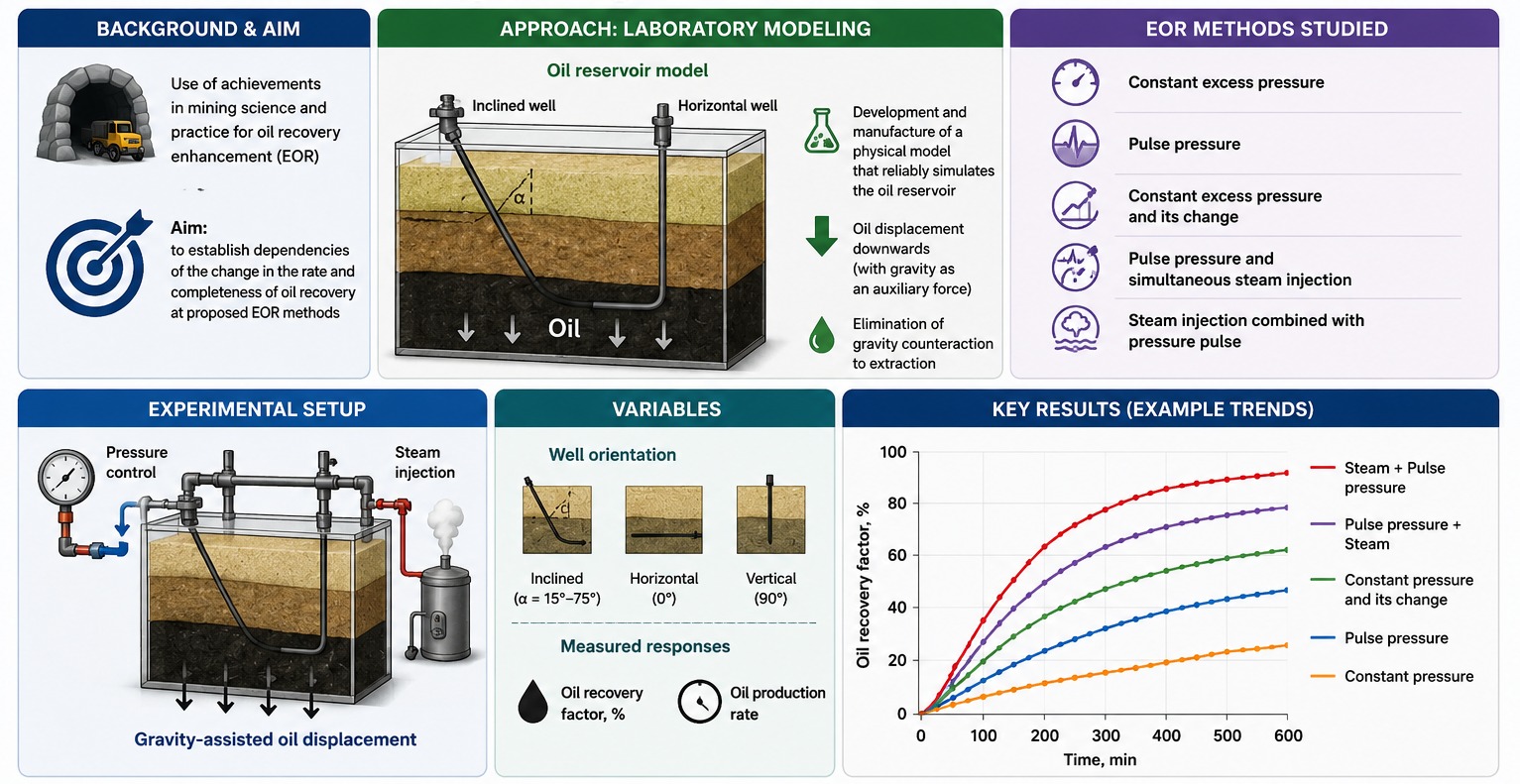
This study presents laboratory experiments aimed at determining rational parameters for Enhanced oil recovery (EOR) technologies based on advances in mining science and practice. The proposed approach employs inclined and horizontal production wells drilled from underground mine workings. Access shafts and connecting crosscuts are excavated in the host rocks surrounding oil-bearing reservoirs using continuous-flow construction technology developed by the D.A. Kunaev Mining Institute. This approach minimizes excavation volumes and capital investment while supporting the underground operations required for efficient reservoir development. Laboratory reservoir models were designed to simulate actual reservoir conditions and investigate the relationships between EOR methods and the rate and completeness of oil extraction. Experiments evaluated well productivity at different inclination angles and used gravity as an auxiliary force for downward oil displacement. Drilling from beneath the reservoir was excluded because of underground safety requirements. The tested methods included constant, pulsed, and variable excess pressure, as well as pulsed pressure combined with steam injection. The results demonstrated the influence of these stimulation methods on recovery efficiency and established quantitative relationships between operating parameters and oil recovery. These findings provide a scientific basis for optimizing EOR technologies in reservoirs developed using mining methods.