Engineering Carbonaceous Char from Hydrocarbon-Containing Wastes Through Pyrolysis: Structure–Property Relationships
Abstract
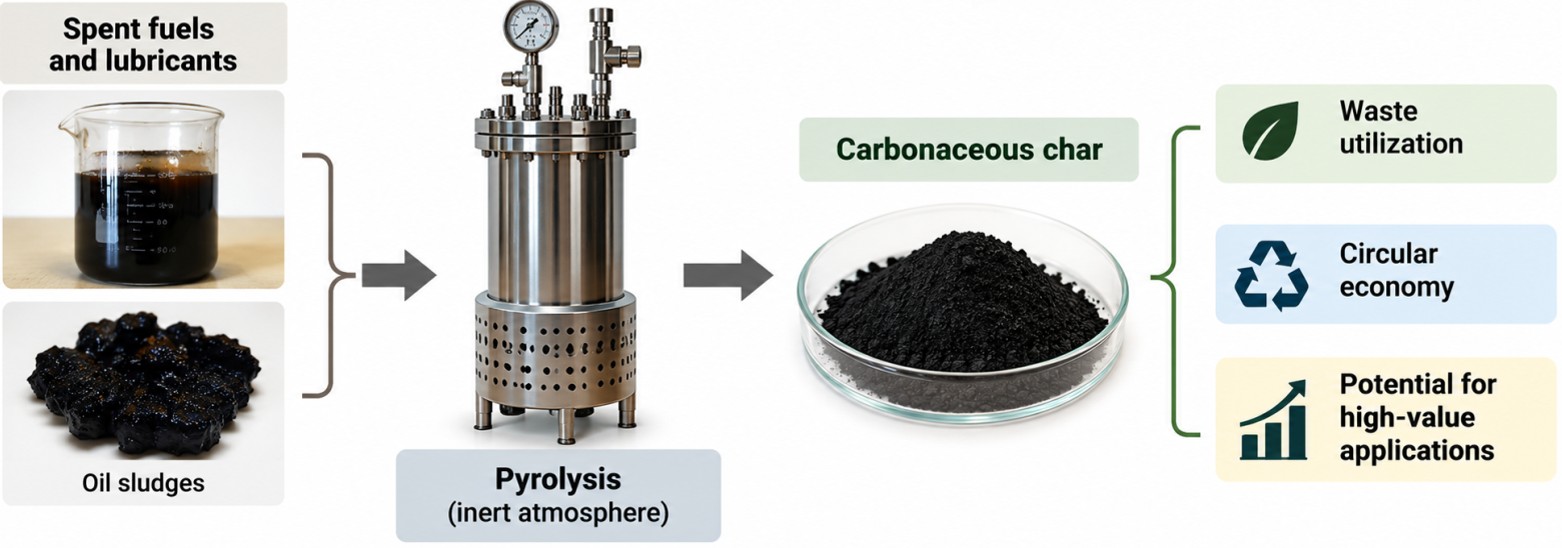
Carbon containing materials were produced from carbonaceous char synthesized from spent lubricating oil and fuels (CC–SL) and carbonaceous char synthesized from oil sludges (CC–OS) via pyrolysis at 450 °C for 60 min under a nitrogen atmosphere to prevent oxidation. The obtained materials were characterized by scanning electron microscopy (SEM), energy-dispersive X-ray spectroscopy (EDX), Fourier transform infrared spectroscopy (FTIR), and thermogravimetric analysis (TGA)/differential scanning calorimetry (DSC). CC–SL showed a high carbon content with minimal mineral impurities, whereas CC–OS contained substantial inorganic residues. The applicability of CC–SL as a functional additive in bitumen was experimentally demonstrated by incorporating 0.2–0.4 wt.% carbonaceous char with 1.5 wt.% Elvaloy polymer, increased the softening point from 49 °C to 56 °C and decreased penetration from 83 to 67 (0.1 mm), indicating improved stiffness and thermal stability suitable for high-load pavement applications. Overall, controlled pyrolysis of carbon-containing wastes enables the production of value-added carbonaceous char materials, linking feedstock composition, structural features, and functional performance. These findings demonstrate a sustainable pathway for valorizing petroleum industry wastes into functional materials for asphalt modification, composites, and environmental applications, emphasizing both scientific novelty and practical relevance.