Vertically Aligned Multifunctional Polyimide-Based Phase Change Composites with Synergistic Regulation of High Thermal Conductivity, Low Leakage, High Enthalpy and High Photothermal Efficiency
Abstract
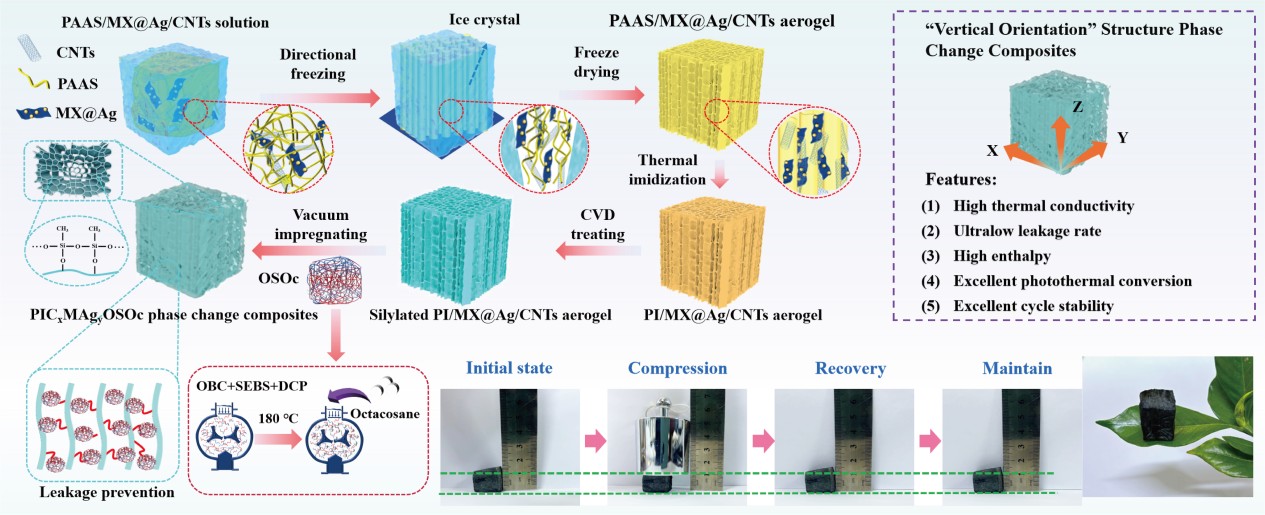
Phase change materials (PCMs) are pivotal in solar energy utilization and thermal management, yet developing materials with high melting enthalpy, efficient photothermal conversion, and robust leakage resistance remains challenging. This study employed a multilevel design integrating interfacial polymerization with ice templating to fabricate a polyimide/carbon nanotubes/MXene@Ag (PI/CNTs/MXene@Ag) aerogel skeleton with vertically aligned channels. To mitigate leakage, a double-network Olefin Block Copolymer/Styrene-Ethylene-Butylene-Styrene/Octacosane composite (OBC/SEBS/OSOc) was synthesized via chemical cross-linking and vacuum-impregnated into the aerogel. The high porosity enabled the optimal OSOc composite to achieve a high melting enthalpy of 208.05 J·g-1, closely approximating that of pure OSOc (219.92 J·g-1). Furthermore, chemical vapor deposition modification enhanced interfacial interaction, yielding exceptional anti-leakage stability of PIC3MAg30OSOc with a negligible leakage rate of 0.62% after 30 minutes at 100 °C. Attributed to the vertically aligned architecture and highly conductive fillers (CNTs and MXene@Ag), an oriented thermal conduction network was established, enhancing the thermal conductivity of PIC3MAg30OSOc to 0.511 W m-1K-1 - a 324.5% increase compared to the PIOSOc. The composite also exhibited broad-spectrum light absorption and a photothermal conversion efficiency of 98.61%. With minimal leakage, high enthalpy, and exceptional photothermal performance, this PI-based phase change composite shows substantial potential for solar energy storage, building heating, and wearable thermal management systems.