Facile Fabrication of Polydimethoxyaniline-Platinum Nanoparticles Adorned on Graphitic Carbon Nitride Modified Electrode: An Efficient Anode Electrocatalyst for Oxidation of Methanol
Abstract
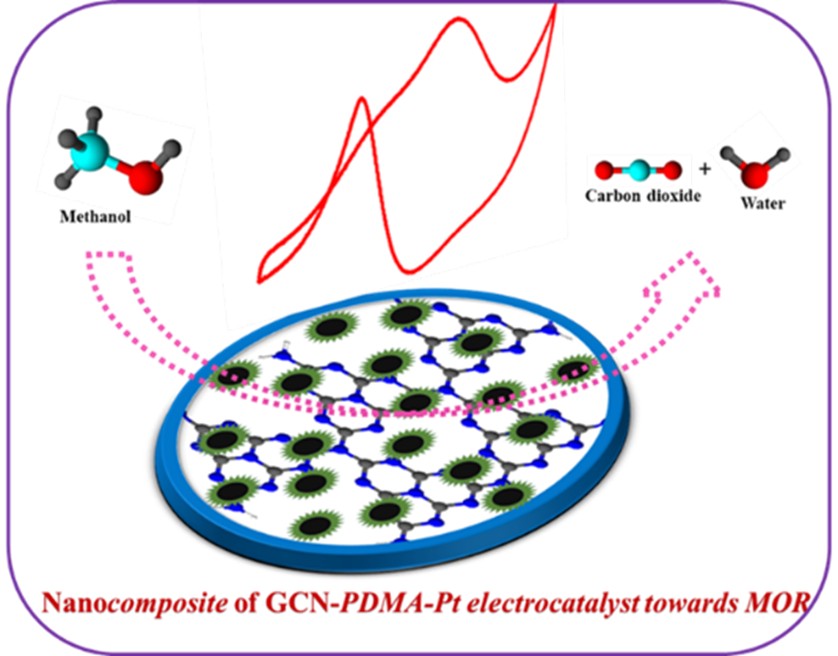
Direct Methanol Fuel Cells (DMFCs) are a promising energy source due to their numerous advantages. In the context of methanol electro-oxidation in acidic conditions, this study presents a straightforward and efficient synthesis of poly(2,5-dimethoxyaniline) (PDMA) along with platinum (Pt) as a precious metal catalyst over graphitic carbon nitride (GCN), resulting in the FTO-GCN-PDMA-Pt electrocatalyst modified electrode via an electro-deposition strategy. The morphology, molecular vibrations, and crystal structure of the GCN-PDMA-Pt composite were analyzed using field emission scanning electron microscopy (SEM) with energy dispersive X-ray (EDX) mapping, Fourier transform infrared (FT-IR) spectroscopy, and X-ray diffraction (XRD) techniques. Electrochemical characterization was carried out using cyclic voltammetry (CV), electrochemical impedance spectroscopy (EIS), and chronoamperometric methods. The FTO-GCN-PDMA-Pt modified electrode exhibits a high electrochemically active surface area (ECSA) of 57 m2/g, a low oxidation potential of 0.83 V, and high current densities of 3.31 mA/cm2 in the forward direction and 2.27 mA/cm2 in the reverse direction, demonstrating superior electrocatalytic performance. Furthermore, the onset potentials for the forward and reverse reactions are observed at 0.22 V and 0.24 V, respectively, indicating excellent anti-CO poisoning resistance during methanol oxidation.