Characterization of Stainless Steel Corrosion in the Petroleum Industry: A Review
Abstract
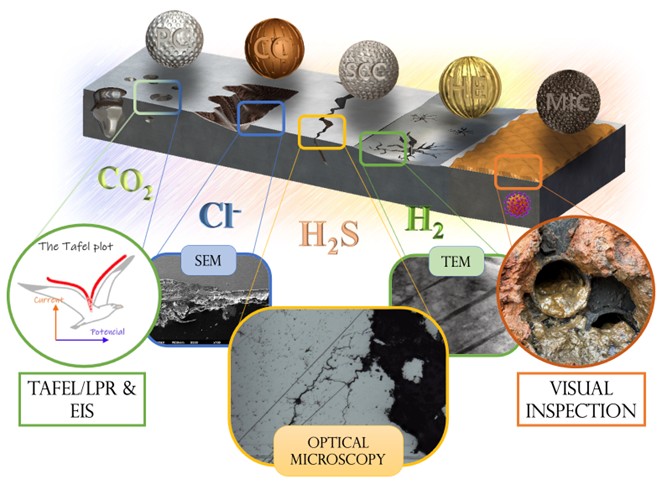
Corrosion of stainless steels in the petroleum industry represents a serious problem because it not only results in major economic losses but also creates environmental hazards through leaks, spills, and long-term ecological impact, and therefore understanding how these alloys degrade under service conditions has become an essential research focus. In this review, particular attention is given to localized forms of corrosion, including pitting, crevice corrosion, stress corrosion cracking, hydrogen embrittlement, and microbiologically influenced corrosion, which frequently occur in combination in sour and chloride-rich environments, making their identification and prediction under real operating conditions especially challenging. To investigate these mechanisms, a wide range of electrochemical methods such as Tafel extrapolation, linear polarization resistance, and electrochemical impedance spectroscopy have been employed, while complementary approaches including autoclave exposures and advanced surface characterization techniques such as scanning electron microscopy, transmission electron microscopy, and X-ray photoelectron spectroscopy provide detailed insights into passive film breakdown and corrosion morphology. Finally, the review considers the strategies most often used to mitigate corrosion in oil and gas facilities. These include alloy selection, qualification under international sour service standards, surface treatments, cathodic protection, and the application of corrosion inhibitors.