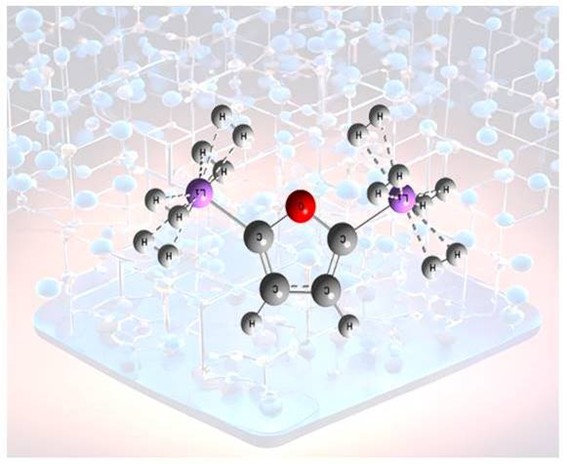
Li-doped Furan Derivatives as New Class of Hydrogen Storage Material - An In Silico Study
Abstract
The transition to a sustainable energy future necessitates exploring viable hydrogen storage solutions. While hydrogen holds immense potential, current storage methods face challenges in density, safety, and infrastructure requirements. This study focuses on the hydrogen storage capabilities of metal-decorated aromatic heterocyclic systems, specifically Lithiated Furans. Using computational methods, we investigated the stability, reactivity, and hydrogen adsorption properties of Furan-1Li and Furan-2Li. Our findings indicate that these systems can effectively store hydrogen, meeting the targets set by the U.S. Department of Energy. Calculations of binding energies, gravimetric weight percentages, and Gibbs free energy changes support the feasibility and spontaneity of the hydrogen adsorption process. The Furan-1Li system showed moderate adsorption energies (−0.138 to −0.095 eV/H₂) with increasing wt.% (2.63–11.91%) indicating favourable and reversible hydrogen adsorption. In contrast, the Furan-2Li system became more physisorptive at higher loadings e.g. −0.101 eV/H₂ and gravimetric wt. % 15.38. These results suggest that Furan-2Li, especially at higher hydrogen coverage, is promising for efficient and reversible hydrogen storage. The Furan-2Li@nH₂ systems (where n = 2–8), the Gibbs free energy change (ΔG) is negative at 150 K, indicating that hydrogen adsorption is spontaneous across this range. In contrast, for Furan-1Li@nH₂ systems (where n = 1–3), ΔG is also negative but only at 50 K, suggesting spontaneity at low hydrogen coverage and low temperatures. However, at higher hydrogen loadings (n = 4, 5), the Furan-1Li systems show positive ΔG values even at 50 K, indicating non-spontaneous adsorption under those conditions. Comparative studies on Na/K decorated furan systems show that these are not a good candidate for hydrogen storage as compared to Li. The analysis of electron localization functions, atom in molecules, and non-covalent interactions further elucidates the bonding nature within these systems. This research highlights the potential of Lithiated furans as promising materials for hydrogen storage, contributing to the development of efficient and sustainable energy storage technologies.