Volatile Components in the Extracts from 20 Herbaceous Plant flowers
Abstract
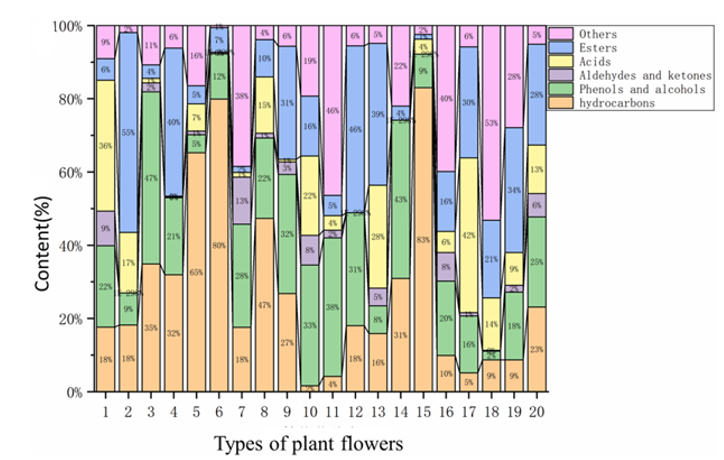
In this study, thermal stability analysis (TG-DTG) was employed to investigate the thermal decomposition process from 20 herbaceous plant flowers. The results indicated that the decomposition of the majority of the flowers commenced at approximately 150℃ and was completed by around 600℃, with carbonization typically initiating around 300℃. In this research, X-ray fluorescence spectroscopy (XRF) was utilized to analyze the elemental composition of 20 herbaceous plant flowers. The results showed that Paeonia lactiflora Pall. Flowers and so on have higher inorganic content, while Cyperus rotundus L. flowers and so on have higher carbon content. In this study, Fourier transform infrared spectroscopy (FTIR) was utilized to explore the functional groups in the ethanol extracts of 20 herbaceous plant flowers. The results demonstrated that the ethanol extracts of these 20 herbaceous plant flowers displayed characteristic C=C stretching vibrations in the range of 1700-1610 cm-1. This spectral characteristic implies the potential presence of valuable bioactive compounds, including flavonoids, amino acids, and alkaloids. Gas chromatography-mass spectrometry (GC-MS) analysis of the flower extracts from 20 herbaceous plant flowers unveiled that these extracts encompass compounds with diverse bioactivities.These provide a basis for its resource utilization.